
a train of flowers
strung across the waves
a wreath
bringing up the rear
like a flower girl
© 2015 Douglas J. Westberg
a train of flowers
strung across the waves
a wreath
bringing up the rear
like a flower girl
© 2015 Douglas J. Westberg
[This column first appeared in slightly different form on Gather in 2012]
 Dear SunWinks! Symbiotes:
Metonymy! (gesundheit…)
Pardon my Greek… The word “metonymy” itself may look as arcane and hairy as, say, onomatopoeia, but like onomatopoeia, you can find metonymy almost anywhere you look! Metonymy (meh-TAWN-i-mee) is the rhetorical figure in which an object is referred to by substituting something—usually smaller and more concrete—that is related to, symbolic of, or a constituent of that object.
An individual instance of metonymy is called a metonym. The type of metonym which consists of a constituent or component part of the object referred to is called a synecdoche (sin-ECK-duh-key). We use metonyms every day without even thinking about it. Here are a few familiar examples. You can think of dozens more. Continue reading




Dear SunWinkers!
This is a lightly reworked reissue of my September, 2012 column for Gather.com on the topic of Abstract and Cubist Poetry. I also urge you to read our recent SunWinks! columns on Edith Sitwell and Intrinsic Rhythm and Cubism as these three columns all encourage you to sharpen your sense of the sound, rhythm, and structure of your writing by putting aside considerations of meaning.
* * *
Well, we’re all done with modern poetry. I’ve exhausted every conceivable topic, every possible technique. There’s nothing left to talk about. Just go back through my previous columns and you’ll know everything there is to know about writing modern poetry.
Did I have you going for a second?
The fact is, there is no end to the invention, the creativity, and the variety of modern poetry and approaches to modern poetry. Think of how many stylistic genres and individual styles there are in modern painting, to name just one medium. Think for just a moment about the unique visions of Monet, Mondrian, Matisse, Miro, Grandma Moses, and M.C. Escher.
As I’ve said, and tried to demonstrate, poetry is much more than sentiment, short lines, and end rhymes. The techniques that can be used to communicate the very special, intimate truth that lives in the poetic imagination are as rich and variegated as the colors in the artist’s palette, or the harmonic colors in the music composer’s palette.
 Now I’m inviting you to go wild. Let loose. Be creative. Pull out all the stops. Put all the leftovers into the stew. Throw the paint onto the wall. Play the piano without the music—with your fists, even. Continue reading
Dear SunWinkers:
In recent weeks, we’ve been backing and filling on topics in the area of the sound and sonority of the language, including a couple ideas, neologism and tumbling verse, which we hope encouraged you to think about sonority and rhythm in new ways. Another way of sharpening your acuity on such considerations is to deprive yourself of the benefit of line breaks. When you do that, you end up with a
Seemingly a contradiction in terms, the phrase may refer to
Babette Deutsch, Poetry Handbook: A Dictionary of Terms [NY, NY: HarperResource 2002 reprint].
*i.e. not didactic, not arguing a point from logic and reason, as an essay
**Examples of type #2 include James Joyce’s Finnegans Wake and E.A. Poe’s “Eleanora.” We are going to ignore definition #2 for obvious reasons and focus on definition #1. Continue reading
Dearest hardy, intrepid SunWinkers:
I frequently badger you to read your poetry aloud, and today’s column is no exception. Writing poetry without hearing what it sounds like is like studying a piano etude without touching the keyboard. For about a year, I’ve been making the rounds of poetry open mikes here in Vancouver USA and trying to be a good citizen of the poetry community. Reading your poems to an audience is so valuable, I just can’t recommend it highly enough!

Ghost Town Poetry open mike, February 12, 2015
You get to hear it aloud, hear yourself read it, see what the audience responds to and what falls flat and what flies over their heads. It builds confidence in public speaking and in yourself as an artist. I’ve grown immensely from doing this. Here’s a sample, from January’s Ghost Town Poetry open mike: http://youtu.be/4Cdg3JWppk4?t=20m
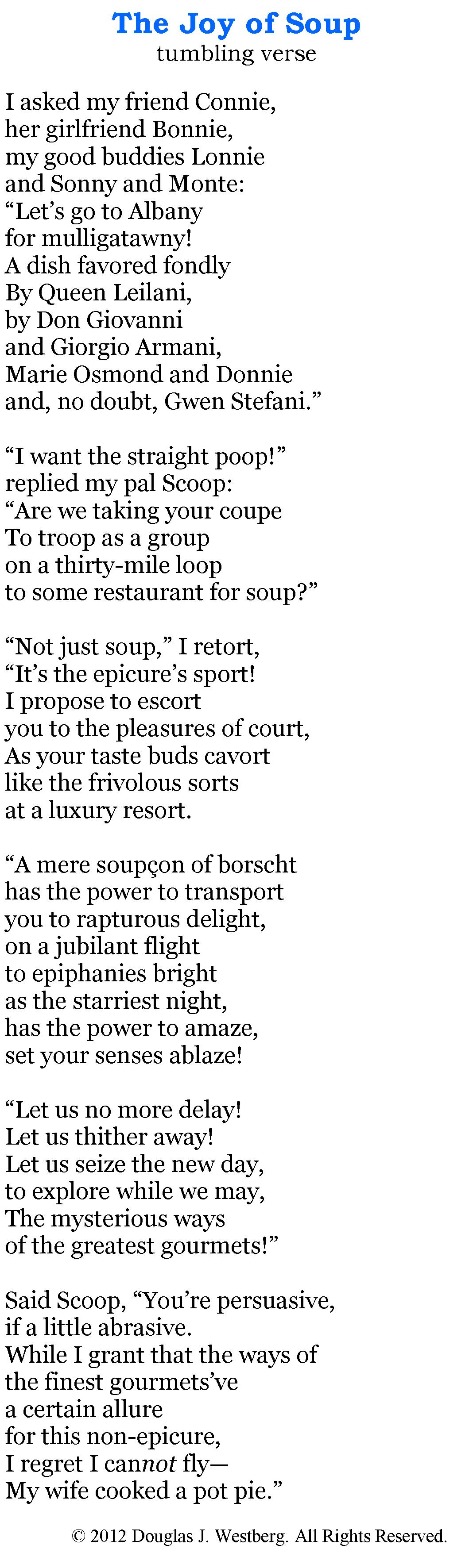
This week, we bounce from Metaphors 201 back to considerations of rhythm and sound. Today’s topic is Tumbling Verse a.k.a. Skeltonic Verse. It’s lots of fun and it’s a great way to experiment with rhythm, pace, diction, sonority, and phonetics. Continue reading
Dear SunWinkers!
As I go through my Gather columns and fill in topics I have not yet addressed here on WordPress with the ultimate goal of producing SunWinks! The Book, we next find the poetic device known as the Metaphysical Conceit.
*sound of jaws dropping to the floor*
Once upon a time, I was reading one of my favorite sourcebooks, which cited Theodore Roethke in a discussion of figurative language:
I nibbled meekly from her proffered hand;
She was the sickle; I, poor I, the rake,
Coming behind her for her pretty sake
(But what prodigious mowing did we make.)
from “I Knew A Woman” © Estate of Theodore Roethke
and went on to say, rather too briefly, “this is what is known as a metaphysical conceit.” [Engle and Carrier, eds.:Reading Modern Poetry; Glenview, Illinois: Scott, Foresman & Co., revised edition 1968. From the Introduction by Lawrence Kramer.] Continue reading
Regrettably, Greg Schiller is having to pull the plug on Writing Essential Group at WordPress. Thank you, Greg, for your service! It’s been a nice forum and it’s been nice to hang on to this clutch of Gather friends. My SunWinks! columns will continue on my blog SunWinks! as usual.
Today, however, I got hit with a last-minute project on a tight deadline, so this is a placeholder for SunWinks! for the moment. The next full column will appear as soon as I can manage it.
I want to say one more thing about oxymorons. “Military intelligence” is not an oxymoron. “I’m from the government and I’m here to help you” is not an oxymoron. These are jokes. The joke is that “military intelligence” should be an oxymoron. The joke is that “military” and “intelligence” are direct opposites.
That doesn’t mean this sort of construction is bad, per se. It’s a great way to construct a one-liner. If you are writing a funny poem and you want to make this technique the basis for a little gag in your poem then by all means do.
Have a great weekend!
Love, Doug
 SunWinks!