SunWinks! July 27, 2014: Ars Poetica

Dear SunWinkers:

SunWinksLogoThere are two ways of classifying poems: One is by form: haiku, sonnet, villanelle, quatrain, rubaiyat, cubist, concrete, etc. The other is by purpose: elegy, ode, pastoral, epic, love poem, etc. One of the latter is, I suppose, inevitable: sooner or later, a dedicated poet of any accomplishment will feel the impulse to write about the poetic process, what a poem is, or what it should be. Such a poem is referred to as an ars poetica, which is Latin for “the art of poetry.” Possibly the most famous is Archibald MacLeish’s “Ars Poetica” :

(…)
A poem should be equal to:
Not true.

For all the history of grief
An empty doorway and a maple leaf.

For love
The leaning grasses and two lights above the sea—

 A poem should not mean
But be.
  Continue reading

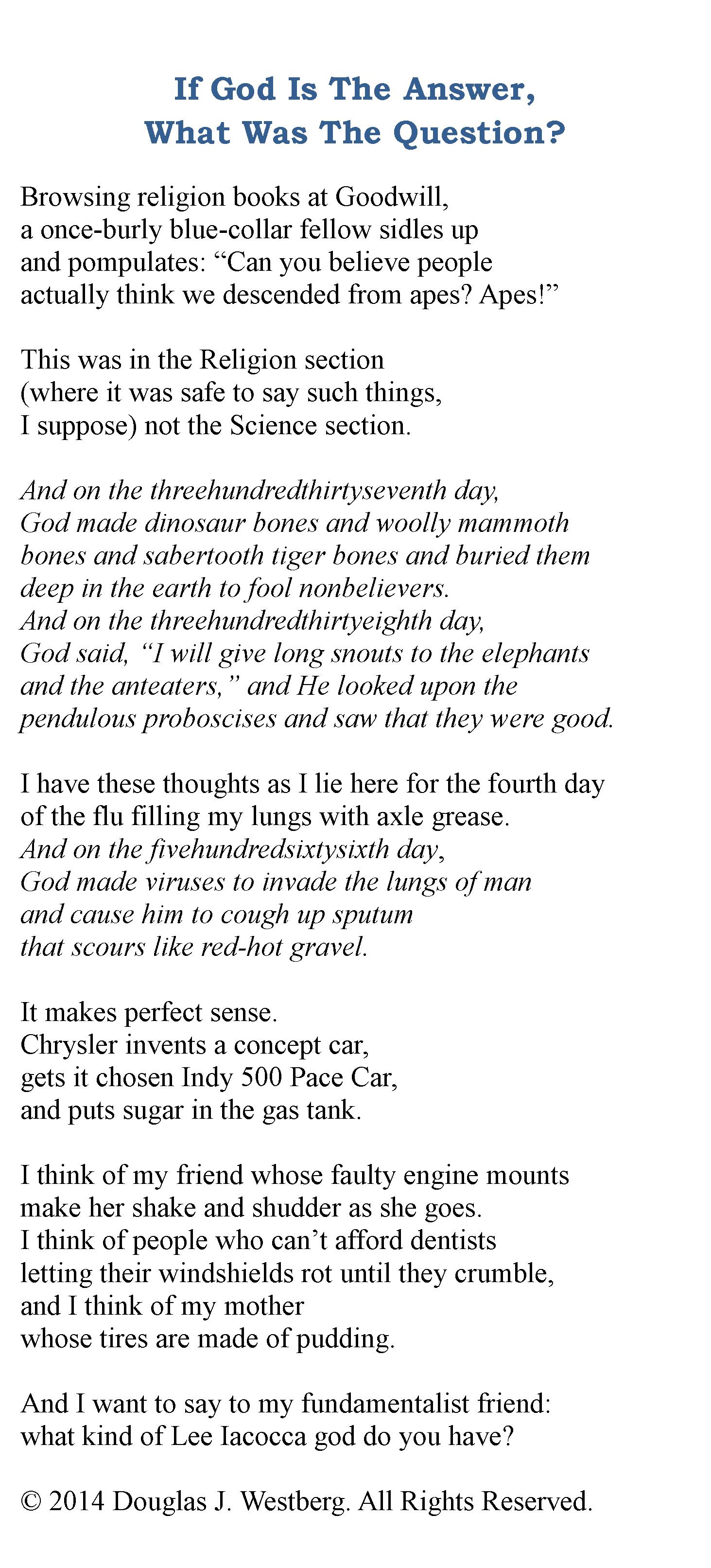
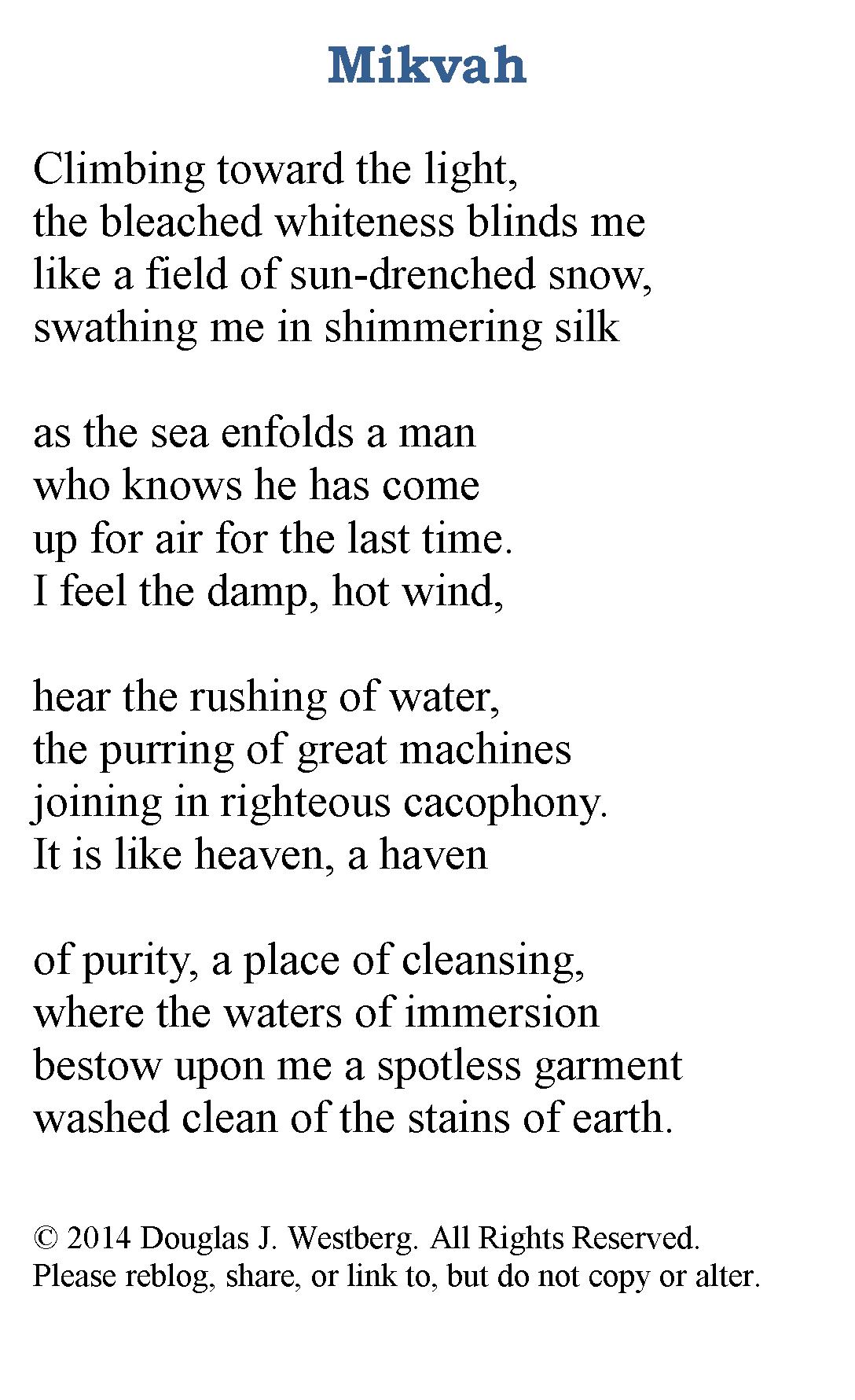
New Poem: Mikvah (formerly: Epiphany)

For those of you, all three of you, who are following my every post with bated breath, this was my initial attempt to write a modern-style* poem about death in response to my own prompt of Sunday. It wasn’t the poem I was trying to write (I succeeded on the second try). Comments welcome.

*When I say “modern-style,” it sounds a little silly, as though I were saying “new-fangled.” What I mean, precisely, is poetry in English in the period 1940-2000.

Update: I’ve been contemplating this some more and decided to rename it “Mikvah.” Mikvah is the Jewish purification ritual of immersion in water.

Mikvah

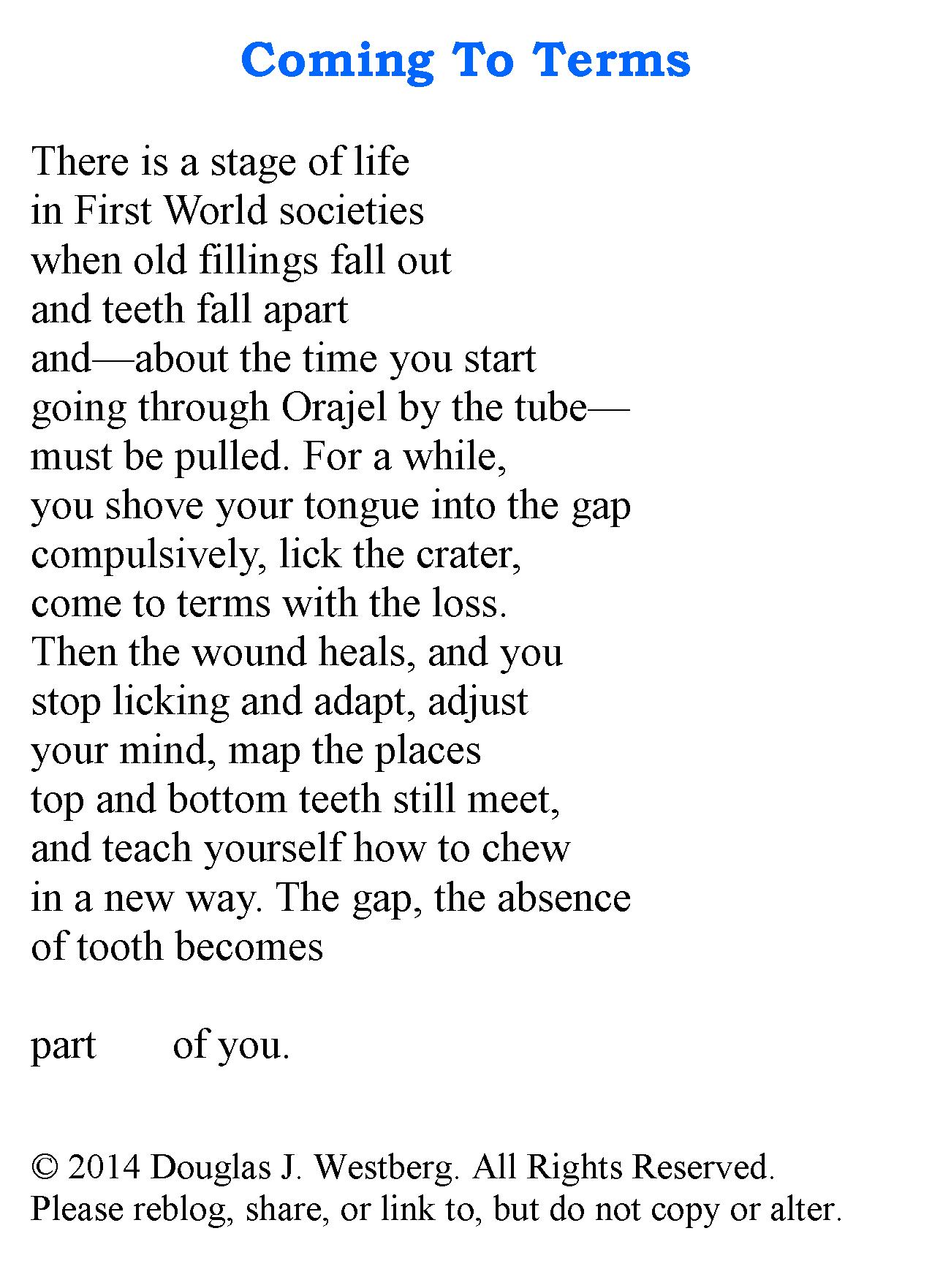
New Poem: Coming To Terms

Gentle Reader:

This is my response to my own prompt of yesterday. It took me two tries, interestingly. The first try turned into a different poem. I’ll post it later in the week.

This is what I meant by approaching the topic obliquely (from the side), metaphorically,  and on a small scale, more or less in the manner of William Carlos Williams and the other poets I cited in the column. This is but one approach; there are many others. Irina has taken a rather more sweeping and literal approach to the prompt and written a beautiful poem.

Coming To Terms


SunWinks! July 20, 2014: Where Is Thy Sting?

Dear SunWinkers!

Out, out, brief candle!
Life’s but a walking shadow, a poor player
That struts and frets his hour upon the stage
And then is heard no more.

            Shakespeare, Macbeth


SunWinksLogoI find myself being rather emotional these days. Last week, I spent four days in bed with the chest flu. This sort of inactivity and helplessness is very problematical for me as a trigger for depression. After another week, I’m still not my better self in terms of energy and industry.

Add to this… Continue reading

Never Cast Pearls Before Swine

My wife Carol’s response to the June 29 SunWinks! Priceless!

cgholden's avatarCarolLines

Casting pearls before swine.  I’m sure you’ve heard that expression. It basically means, to my understanding, that someone has presented something of great worth to someone who doesn’t appreciate it, or perhaps isn’t worthy of it, or wouldn’t know what to do with it.   You probably haven’t ever heard an Aesop fable explaining the origin of the phrase or a story that has a necklace and a pig in it. You haven’t heard anything like that because there is no such story.   Over the years, proverbs and fables get bastardized, morphed, mutated and mutilated, usually by changing or omitting a word or two.  For instance, we say, “Spare the rod and spoil the child” which means, be kind to the child and don’t spank  him.  But the original phrase was “Spare the rod and YOU WILL spoil the child”, which has just the opposite meaning.  Another one that has been…

View original post 833 more words

Exercise: Twenty Two Words from Eliot

Twenty-Two Words from Eliot


Burnt, I circumambulate my maisonette
in protozoic stupor,
mulling hollow images formulated
from the sawdust
of etherised metaphysics.

Outside the window-panes,
sun-kist hyacinths
dance with the arboreal shadows
falling across my tea and marmalade,
but I conjure only
broad-bottomed sea-girls
in ragged trousers.

Empty, I whimper
like a fugitive.
                             Empty
is the cruellest word.


© 2014 Douglas J. Westberg. All Rights Reserved. Please share, link to, reblog, but do not copy or alter.


The prompt (adapted from The Poet’s Companion [Kim Addonizio and Dorianne Laux; New York: W.W. Norton, 1997]):

Skim several books of poetry by, perhaps, your favorite poets. Without paying too much attention to the context, jot down words that strike your fancy. Go through the resulting list and pick out about twenty of these. Fashion them into a poem, using these words and as few other words as possible.

In this case, I started with a list of twenty words exclusively from T.S. Eliot poems. (I added “burnt” and “tea” as I went along.)

SunWinks! July 13, 2014: The H.M.S. Metaphor Goes On Extended Holiday

SunWinks! July 13, 2014: The H.M.S. Metaphor Goes On Extended Holiday

Dearest SunWinkers!

SunWinksLogoWe’ve been talking about metaphor in our language (that’s how it’s built) and our poetry (it wouldn’t be very poetic without it). Metaphors—and successful poetry—make us look at things in new ways by making fresh connections among diverse ideas.

An extended metaphor is a comparison that is carried out through an extended part or the entire length of a work. Some writers say it is synonymous with allegory. I think they are two different things, but I don’t have the energy to belabor the point here.

Here is a tiny sample of poems which use extended metaphors. Browse your favorite anthology to find many more. They shouldn’t be too hard to pick out. In fact, it occurs to me this would be a fabulous exercise!

Continue reading

Excerpt: You Can Talk!

You Can Talk!

from The Golden Books
Copyright © 2012 Douglas J. Westberg. All Rights Reserved. International Copyright Secured.

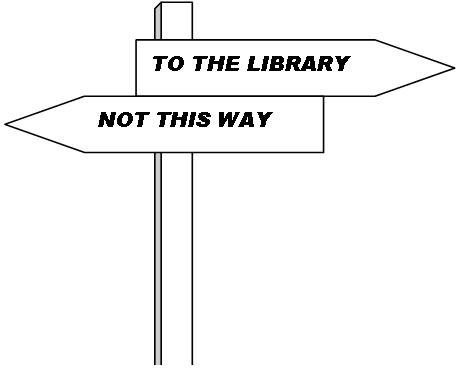
Now which way did she tell me to turn?…   Everything had been so surreal, Gus realized he wasn’t quite sure exactly what Gaia had said. Then his eyes fell upon a sign across the road. It looked like this:
To The Library
“Curiouser and curiouser…” Gus grinned, amused at his literary allusion. Then, addressing himself to no-one in particular, “Well, whaddya say, shall we go to the… library?” Continue reading