SunWinks! July 6, 2014: H.M.S. Metaphor Sails Again

SunWinks! July 6, 2014: The H.M.S. Metaphor Sails Again

Dear SunWinkers!

A tasty confection the metaphor,
As sweet to an ode as a petit four,
A friend to the scribe,
Which, aptly applied,
Your poem will be so much the better for.

Last week, we introduced the idea that our language is built through metaphor. There were so many great stories to choose from, and all from just the one book: Loose Cannons, Red Herrings, and Other Lost Metaphors by Robert Claiborne [New York: W.W. Norton & Co., 1988]. (I have half a dozen others.) So this week, I’m just going to throw out a few more word stories and let you either work on last week’s prompt, or a completely different prompt which I’ve supplied below.

Annie Oakley

Phoebe Anne Oakley Mozee, a.k.a. Annie Oakley, gave shooting exhibitions in Buffalo Bill’s Wild West Show in the late 1800s. One of her most famous tricks was to throw a playing card into the air and shoot a hole in it. In that era, “comps,” complimentary tickets for theater or sporting events, had holes punched in them to prevent them being resold. Ban Johnson, founding president of the American League, took to calling such comps “Annie Oakleys,” and the name stuck. Later on, the nickname came to refer to other freebies, such as a walk in baseball. Alas, the nickname is virtually forgotten today.

Have you ever thought about where the name “cockpit” came from? As you might guess, it’s just what it looks like, a reference to the small sunken pits in which cockfights were held. A metaphorical cockpit is any small space in which intense fighting takes place, hence its application to the pilot’s compartment of a fighter plane. Continue reading

Humor: Our Living Language

Our Living Language

 You may have heard the expression “get a wild hair up your butt.” In current usage, it usually refers to a person who is particularly exercised over some problem. Why on earth, you probably thought to yourself, would a hair up one’s rectum cause maniacal behavior? After all, how aggravating can one little hair be? And while we’re about it, how did it get there?

The illogic of this has caused some modern writers to write “get a wild hare up one’s butt”—presumably because having a wild rodent lodged in one’s anus would indeed cause rather animated behavior. But this, of course, is ridiculous. The largest rodent ever lodged in a human rectum is a small hamster, as reported in the August, 1997, issue of the New England Journal of Medicine by a physician at Cedars-Sinai Hospital.

Bugs BunnyThe reality is quite an interesting story, and illustrates how our language develops over time. The first thing that needs to be said is that “up your butt” is a typical crude accretion added for emphasis in recent times and has nothing to do with the origin of the phrase, which in no way involves a medical condition such as might be presented to a proctologist. Continue reading

SunWinks! June 29, 2014: Aboard the H.M.S. Metaphor

SunWinks! June 29, 2014: Aboard the H.M.S. Metaphor

Dear SunWinkers!

Where are all the haikais? I expected to be inundated with poo-kus. Well, there are no deadlines at SunWinks! Get them in when you can—it’s never too late.

Important note: if SunWinks! and Writing Essential Group are to survive and thrive, it is imperative that you do your part by sharing these columns with your communities on WordPress, Facebook, Twitter, StumbleUpon, Pinterest, Google+, whatever. We can’t build a community without your help.

On to today’s topic: Metaphor. That stampeding of hooves you hear is the self-described “non-poets” running as fast as they can in the other direction. I get the same reaction every time I mention that word: “I just don’t understand poetry.”

The inescapable fact is that you pretty much cannot write a poem without using metaphor in some form or fashion. But here’s the thing: you also pretty much can’t talk without metaphor. Metaphor is one of the building blocks of language. Teachers and public speakers know the value of metaphor. Our speech is chock full of metaphor whether we’re aware of it or not. “Stampeding of hooves” above is a metaphor—so is “running as fast as they can etc.”. Metaphors are the stock in trade, the coin of currency (there are two more metaphors!), of any writer who strives to be more colorful than dishwater (that’s a simile).

Continue reading

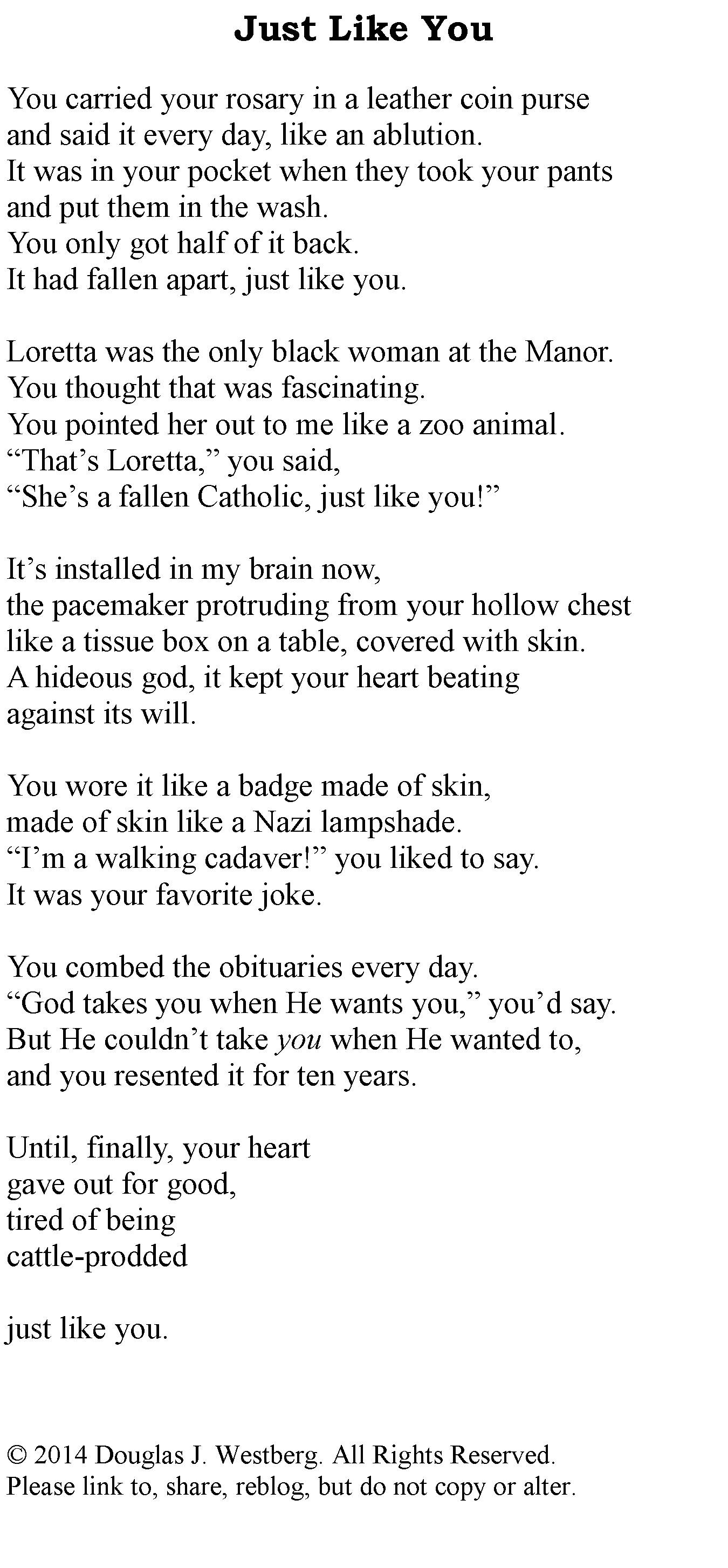
Memoir: The Pacemaker

The Pacemaker

Ten years ago, Dad couldn’t get himself out of bed. Mom called the ambulance. One week and a quarter of a million dollars later, Dad had two bovine heart valves and a pacemaker courtesy of world-famous heart surgeon Albert Starr. Dad was not grateful. He continued to abuse my mother, push her around, lean on her, and make horrible jokes like “I’m a walking cadaver.” Five years later, Mom was thrown to the floor on a train and broke her hip and was taken to the hospital in Centralia, a hundred and some miles north. Dad never visited Mom in the hospital up in Centralia once. Any of us kids would have taken him from door to door. When she was transferred back to town to a convalescent center, where she stayed for two months, Dad visited one time. When she finally got home, Dad went right back to making her wait on him, even as she was trying to rehab from her hip replacement.

Continue reading

SunWinks! June 22, 2014: Go Take A Haiku, Part Deux

Go Take A Haiku, Part Deux

Dear SunWinkers!

We’ve been talking about haiku, that ancient Japanese party game. Instead of gathering together to play Twister or Grand Theft Auto, 12th century Japanese poets would get together and write renga, collaborative poems of verses in syllables 5-7-5, 7-7, 5-7-5, 7-7, etc., going around the room, each person contributing another verse, ultimately running to hundreds, even thousands of verses. It was quite an honor to be chosen to contribute the starting verse, called the hokku.Poets would come to renga parties prepared with dozens of hokku, and would inevitably go home with lots of leftover hokku. So they would publish books of hokku, and hokku became an art form unto itself.

About the 16th century, various art forms became the province of the hoi polloi rather than just the royalty; these included Kabuki theatre, woodblock prints, and hokku. The popular hokku degenerated into something very much the equivalent of the bawdy limerick. They called these haikai, which means “unusual fun.” Basho (1644-1694) is credited with raising the art of the hokku/haikai once again to something more sublime. What’s easy to overlook is that Basho and others did not always have their heads in the clouds. They were not above writing personal, droll epigrams and even getting scatological. Continue reading

Story: The Honey Badger

The Honey Badger

from The Golden Books
Copyright © 2012 Douglas J. Westberg. All Rights Reserved. International Copyright Secured.

Then Gus noticed something right behind Tucker. “Don’t move!” he whispered

Tucker heard the maraca sound. “It’s a rattlesnake, isn’t it?”

“Oh my God, Tucker, what do we do? I’ll get a stick.”

“Don’t you move either. Either one of us moves, I’m dead.”

“Okay.”

A minute went by. Then two. It seems like hours. Then Gus noticed Tucker had moved imperceptibly. “You’re moving,” he whispered.

“Shh.” Tucker was moving so slowly, Gus couldn’t even see him moving. It was like watching grass grow. He could only tell Tucker was moving when he realized he was in a different position from a minute before. Slowly, infinitesimally, Tucker was turning to face the snake. Gus had never seen anything like it.

Then Tucker made his fatal mistake. His tail twitched. That was enough. The rattlesnake struck.

Kree-k-k-k-kree! Continue reading