humor



SunWinks! February 15, 2015: Take a Tumble
 Dearest hardy, intrepid SunWinkers:
I frequently badger you to read your poetry aloud, and today’s column is no exception. Writing poetry without hearing what it sounds like is like studying a piano etude without touching the keyboard. For about a year, I’ve been making the rounds of poetry open mikes here in Vancouver USA and trying to be a good citizen of the poetry community. Reading your poems to an audience is so valuable, I just can’t recommend it highly enough!

Ghost Town Poetry open mike, February 12, 2015
You get to hear it aloud, hear yourself read it, see what the audience responds to and what falls flat and what flies over their heads. It builds confidence in public speaking and in yourself as an artist. I’ve grown immensely from doing this. Here’s a sample, from January’s Ghost Town Poetry open mike: http://youtu.be/4Cdg3JWppk4?t=20m
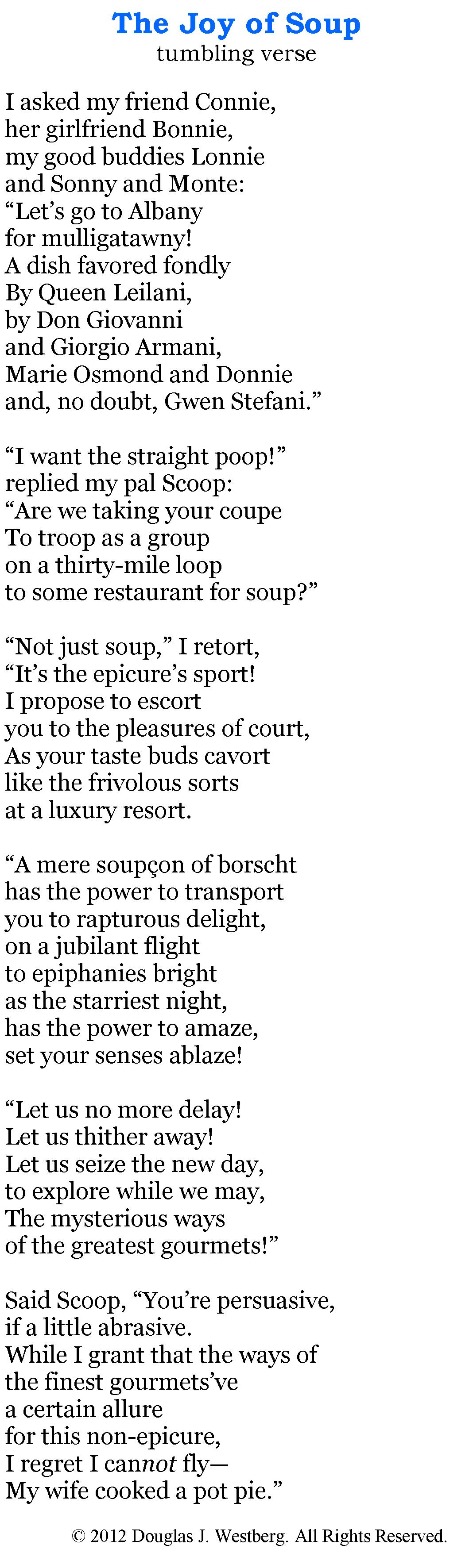
This week, we bounce from Metaphors 201 back to considerations of rhythm and sound. Today’s topic is Tumbling Verse a.k.a. Skeltonic Verse. It’s lots of fun and it’s a great way to experiment with rhythm, pace, diction, sonority, and phonetics. Continue reading
SunWinks! January 5, 2015: Giving It 110%
Dearest SunWinkers:
Sometimes as a writer you have to reach back for something extra. So, as a selfless public service for the betterment of all mankind, our topic this week is hyperbole. Hyperbole is, very simply, exaggeration. It’s an essential tool in the comedian or comic writer’s belt, but it can make any genre of writing more lively. “If I’ve told you once, I’ve told you a thousand times: don’t exaggerate!” is a hyperbole. So is “If I had a nickel for every time you exaggerate, I could retire.” The thing exaggerated might be a quantity or size or some such, but it can also be the absurdity or the banality of something:
“I am two with nature.” Woody Allen
“I went to the Board of Health and asked for two thousand cockroaches. I promised my landlord I would leave my apartment the way I found it.” Anon.
“The scarecrow scared the crows so badly that they brought back the corn they had stolen two years before.” Fred Allen
“You might be a redneck if you’ve ever paid for a six-pack of beer with pennies.” Jeff Foxworthy
“I woke up the next day on a bench in a bus station. My shoes were gone. So was my wallet. So were my kidneys. I’m just kidding. That’s an urban legend. I still had my shoes.” DW, “The Depressed Detective and the Case of Boston Baked Beans”

“I don’t want to achieve immortality through my work, I want to achieve it through not dying.” Woody Allen
When you make something exaggeratedly large, that’s called overstatement. But don’t forget understatement (or meiosis). Making something exaggeratedly small or inconsequential can be equally, if not more, effective.
“I’m not shooting for a successful relationship at this point. I am just looking for something that will prevent me from throwing myself in front of a bus. I’m keeping my expectations very, very low. Basically, I’m looking for a mammal.” Janeane Garofalo.
“As I told the tribunal at Nuremberg, I did not know that Hitler was a Nazi. The truth is that for years I thought he worked for the phone company.” Woody Allen
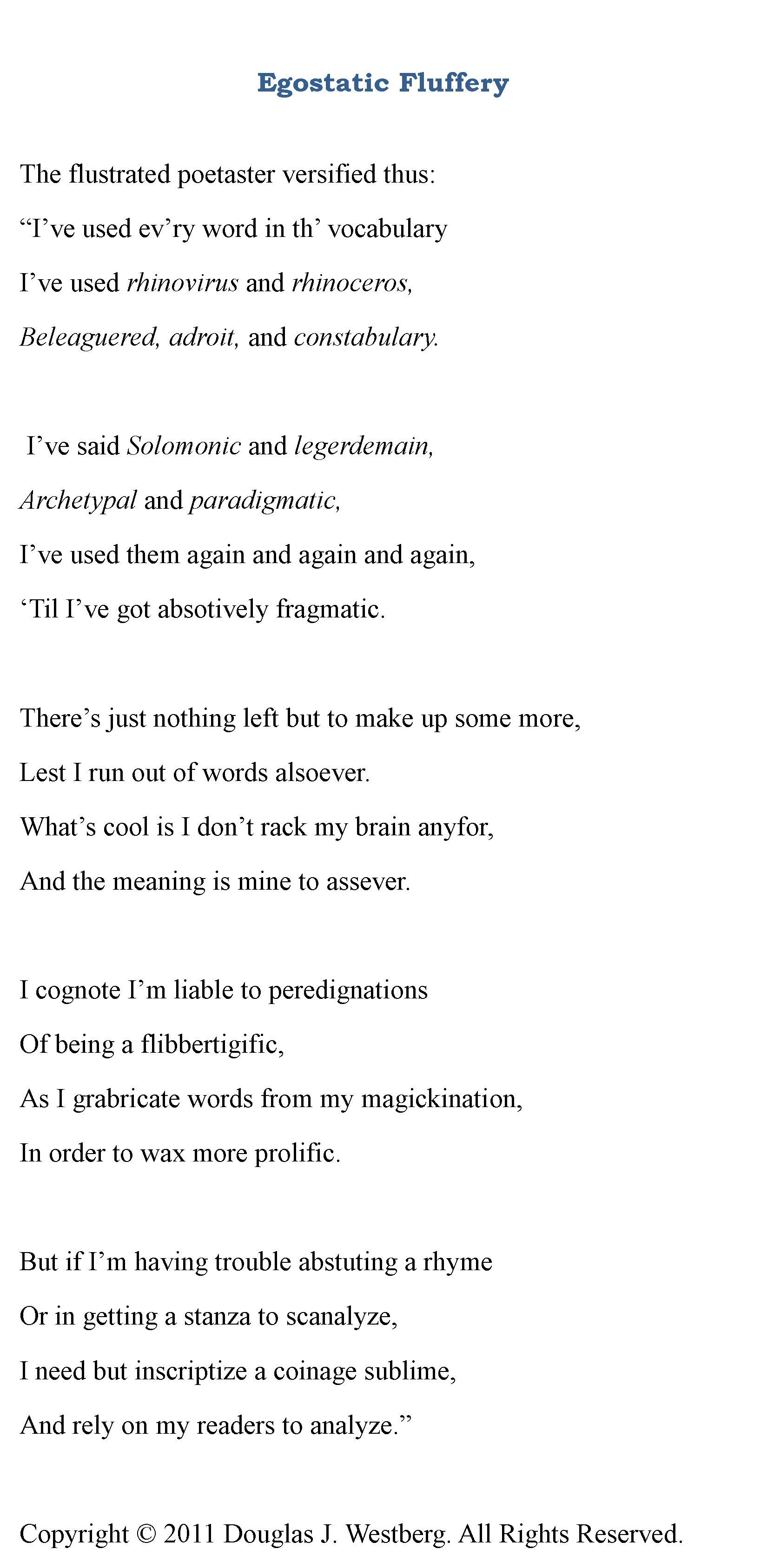
Poem: Egostatic Fluffery
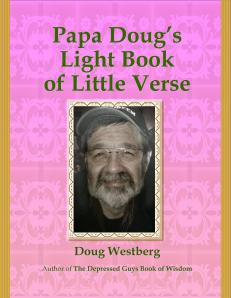
Putting this up as an example for November 16th’s SunWinks! on neologisms. From Papa Doug’s Light Book of Little Verse.
Love, Doug
Caption Contest III
Please put your own captions (one or all…indicate the photo number) in a comment here!
1.

Hell, yah!
2.

So this is the World War II aisle?
3.

You shoulda seen the other cat!
SunWinks! September 28, 2014: Nothing Is Sacred
I think that I shall never see
A poem as trivial as “Trees.”…
Dear SunWinkers!
Joyce Kilmer’s 1913 poem “Trees” is an easy and favorite target for parody. I was shocked to learn that “Trees” was originally published in the prestigious Poetry magazine. (I was also shocked to learn that Joyce Kilmer is a guy.) And you know, looking at it again, it’s not the worst poem ever, especially for 1913.

Joyce Kilmer
Writing parody can be lots of fun, and it can improve your technique and even give you a new appreciation for the poem you are lampooning.
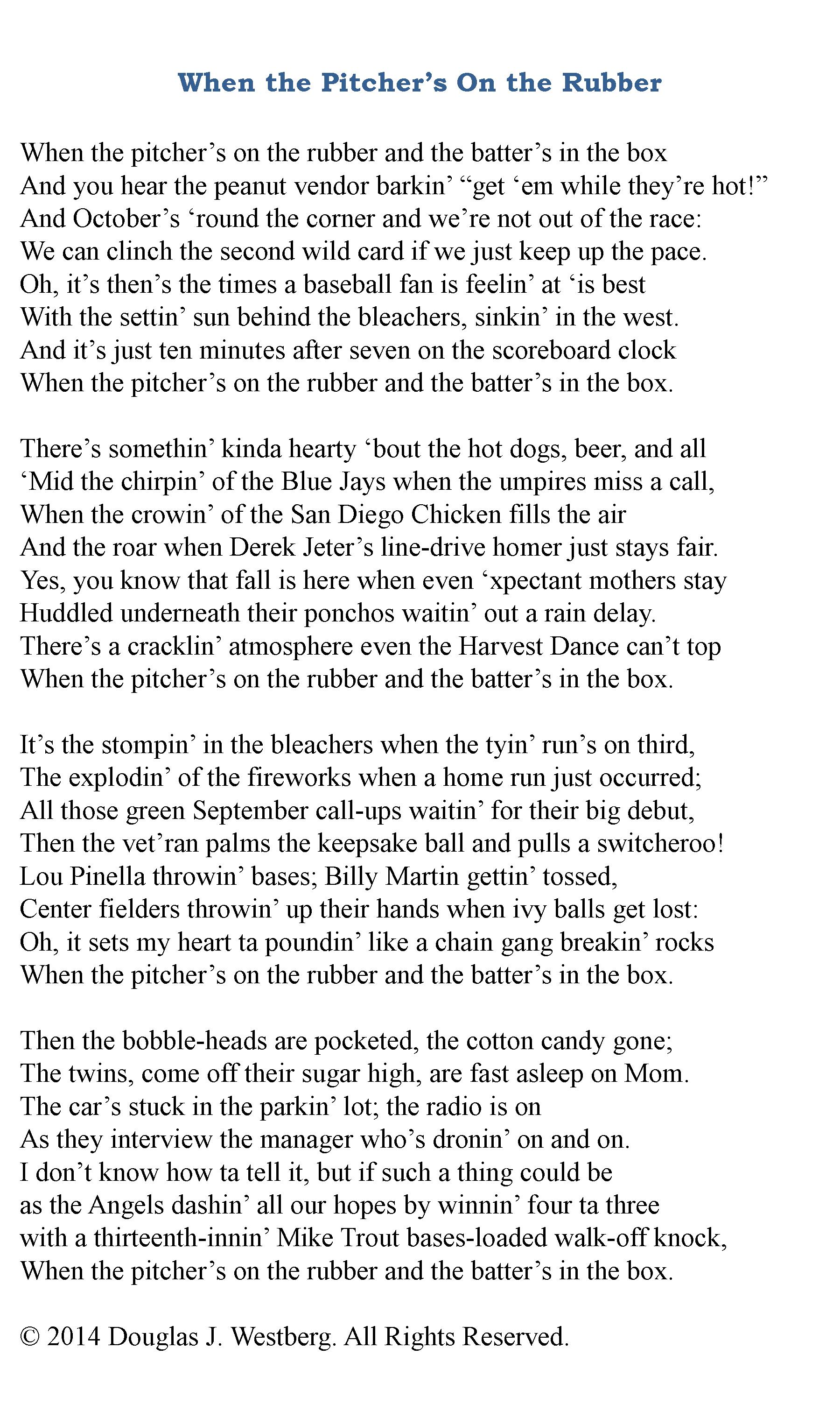
This week, I wrote a parody of James Whitcomb Riley’s “When the Frost Is On the Punkin,” a poem I grew up with. It (the original) is a celebration of crisp autumn mornings on the farm. I heard some baseball commentator say, “The pitcher’s on the rubber, and the batter’s in the box…” and said to myself, “OMG I have to write that!”
New Poem: When the Pitcher’s On the Rubber
I’m sending this to the Chicago Cubs broadcasters Len Kasper and Jim Deshaies. Len and J.D.: I think you’ll enjoy this. It’s a parody of James Whitcomb Riley’s “When the Frost Is On the Punkin.”
Best wishes, Doug Westberg.
[This is my copyrighted work, but I acknowledge submitting this gives you the right to use it any way you like.]
Caption Contest II
The Caption Contest Returns Again once more for the second time! I’ve included my own captions, unlike when we did this on Gather, but please contribute your captions for any or all of these as well. Just put them in a comment with the photo number(s).
1.

The Tower of Babble
2.

To blazz or not to blazz, that is the quezztion…
3.
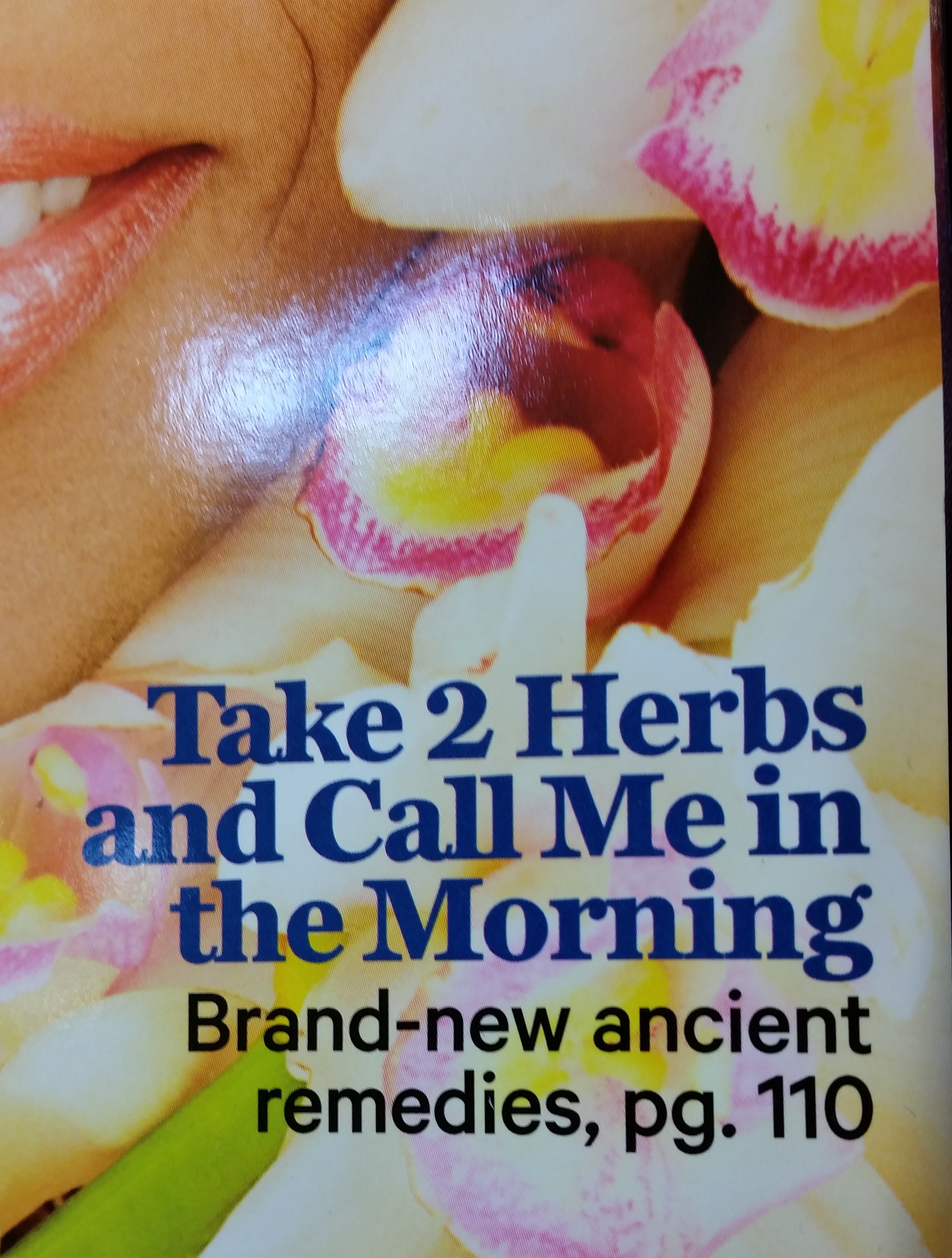
Grandma always said: the best ancient remedies are the brand new ones…
SunWinks! September 21, 2014: Playing the Field
Dear SunWinkers!
“The time has come,” the Walrus said,
“To talk of many things:
Of shoes–and ships–and sealing-wax–
Of cabbages–and kings–
And why the sea is boiling hot–
And whether pigs have wings.”
Lewis Carroll
Well, I got Len to write a poem, so pigs must have wings…..
Anyway, poetry is many things, and consists of many things, and we are going to talk about one of them. Today I want you to think about the placement of the words on the page.
Now, poetry is an oral medium. A good poem must be read out loud, both by the poet in the process of composition, and by the discerning reader.
It follows that the organization of a poem affects how it sounds when read out loud. When it is written in a fixed form, such as a ballad, the form is imposed on the content, and the content must be manipulated to fit the structure. Therefore, much of the music of the poem comes from the superimposed formal structure.
The emergence of open form (or free verse) spearheaded by Ezra Pound and William Carlos Williams in the 1940s is based on the idea that the form of a poem ought to grow organically from the thoughts, words, and breathing of the poet. Pound said that poets should “compose in the sequence of the musical phrase, not in the sequence of a metronome.”
 SunWinks!