
poem
SunWinks! October 12, 2014: I Never Metaphor I Didn’t Like

A good title should be like a good metaphor: it should intrigue without being too baffling or too obvious.
Walker Percy
Dear SunWinkers:
I’ve danced* around it as long as I can. I must come back to the topic of metaphor. This is where I lose* some people. They immediately say, as though they were being confronted with somebody else’s religion,* “I don’t understand poetry!” “I could never write a poem!”
The mission of SunWinks! is to demystify the reading and writing of modern poetry. And so, sooner or later, we must tilt at the windmill* of metaphor. Poetry (as we understand it today) without metaphor is as banal as a greeting card.* Metaphor is the very stuff* of poetry.
*These are all metaphors. I will continue to mark similarly the metaphors in this column.* (yup, that’s another one…)
As you can see already, figurative language (metaphors) makes for compelling and colorful* writing, period, never mind poetry. Language itself is metaphor. Every word, Emerson said, is a metaphor; words are by their nature metaphors–the word “table” represents the four-legged piece of furniture we eat on. Words originate as metaphors; the word “column” refers to the fact that columns in newspapers were usually presented in narrow columns of type. These columns of type were so named as a visual metaphor to the tall, narrow columns which hold up ancient temples. Continue reading

SunWinks! October 5, 2014: Music Without Melody
 Dear SunWinkers!
In the history of art in general and poetry in particular, one of the creative giants and originals among originals is Dame Edith Sitwell. Born in 1887 into an upper-crust family and distant parents, Sitwell was encouraged by her grandmother and governess to write and express herself. From the very infancy of her poetic career, she broke the mold of stuffy, rigorous Victorian English poetry, determined to find a new language and a new approach.

Edith Sitwell. Painting by Roget Eliot Fry (1918).
Not only a pioneer, Sitwell was a celebrity on the order of Gertrude Stein, Picasso, and Dali. So I was gobsmacked to find a vintage 1949 copy of her volume The Canticle of the Rose: Poems 1919-1949 for sale at Powell’s for $3.50. It begins with an invaluable preface: Some Notes on My Own Poetry. I feel like a kid who found an antique wind-up tin soldier in his Cracker Jacks box:
At the time I began to write, a change in the direction, imagery, and rhythms in poetry had become necessary, owing to the rhythmical flaccidity, the verbal deadness, the dead and expected patterns, of some of the poetry immediately preceding us.
SunWinks! September 28, 2014: Nothing Is Sacred
I think that I shall never see
A poem as trivial as “Trees.”…
Dear SunWinkers!
Joyce Kilmer’s 1913 poem “Trees” is an easy and favorite target for parody. I was shocked to learn that “Trees” was originally published in the prestigious Poetry magazine. (I was also shocked to learn that Joyce Kilmer is a guy.) And you know, looking at it again, it’s not the worst poem ever, especially for 1913.

Joyce Kilmer
Writing parody can be lots of fun, and it can improve your technique and even give you a new appreciation for the poem you are lampooning.
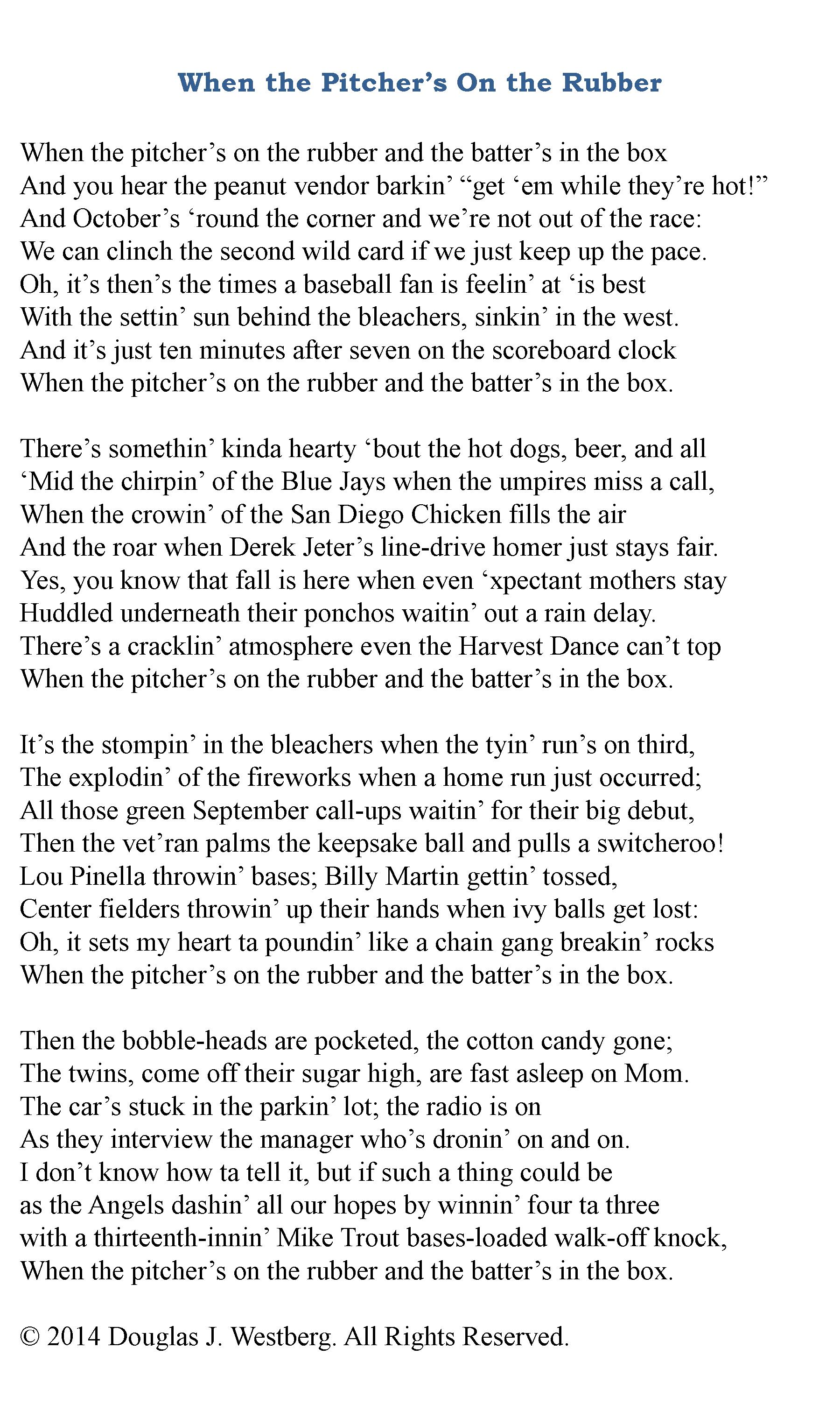
This week, I wrote a parody of James Whitcomb Riley’s “When the Frost Is On the Punkin,” a poem I grew up with. It (the original) is a celebration of crisp autumn mornings on the farm. I heard some baseball commentator say, “The pitcher’s on the rubber, and the batter’s in the box…” and said to myself, “OMG I have to write that!”
New Poem: When the Pitcher’s On the Rubber
I’m sending this to the Chicago Cubs broadcasters Len Kasper and Jim Deshaies. Len and J.D.: I think you’ll enjoy this. It’s a parody of James Whitcomb Riley’s “When the Frost Is On the Punkin.”
Best wishes, Doug Westberg.
[This is my copyrighted work, but I acknowledge submitting this gives you the right to use it any way you like.]
SunWinks! September 21, 2014: Playing the Field
Dear SunWinkers!
“The time has come,” the Walrus said,
“To talk of many things:
Of shoes–and ships–and sealing-wax–
Of cabbages–and kings–
And why the sea is boiling hot–
And whether pigs have wings.”
Lewis Carroll
Well, I got Len to write a poem, so pigs must have wings…..
Anyway, poetry is many things, and consists of many things, and we are going to talk about one of them. Today I want you to think about the placement of the words on the page.
Now, poetry is an oral medium. A good poem must be read out loud, both by the poet in the process of composition, and by the discerning reader.
It follows that the organization of a poem affects how it sounds when read out loud. When it is written in a fixed form, such as a ballad, the form is imposed on the content, and the content must be manipulated to fit the structure. Therefore, much of the music of the poem comes from the superimposed formal structure.
The emergence of open form (or free verse) spearheaded by Ezra Pound and William Carlos Williams in the 1940s is based on the idea that the form of a poem ought to grow organically from the thoughts, words, and breathing of the poet. Pound said that poets should “compose in the sequence of the musical phrase, not in the sequence of a metronome.”
SunWinks! September 14, 2014: Gently Down the Stream
Dear SunWinkers:
Years ago, I was struggling with deep depression, divorce, custody battle, blah blah blah. I started writing poetry as a form of therapy. I would usually begin by doing some automatic writing in my journal, just writing the next word that came into my head without thinking about it, and before you know it, there I would be, writing a poem.
Not too long ago, I wrote an experimental poem, just a goof, really, called “Listening In.” The idea was to “record” (not literally, the poem was a deliberate composition) what I heard and saw and what was going through my mind as I watched a Chicago White Sox broadcast with Ken “Hawk” Harrelson and Steve Stone. The poem leaps from inner thought to external action to thought to action to thought to action.
So, in a way, this is what is called stream of consciousness writing. Stream-of-consciousness writing differs from automatic writing in that the author composes the stream of thought that is putatively going through the character’s head. S-o-c writing eschews punctuation and sentence structure, hurtling along from thought to fragmentary thought. James Joyce, Virginia Woolf, William Faulkner, and Jack Kerouac are notable practitioners. Continue reading
SunWinks! September 7, 2014: Give ‘Em The Fast Shuffle
Dear SunWinkers:
How’s the wife, you ask? Get it from the horse’s mouth at http://carollineswords.wordpress.com ! We went to Carol’s hairdresser today and—well, I’ll let her tell you.
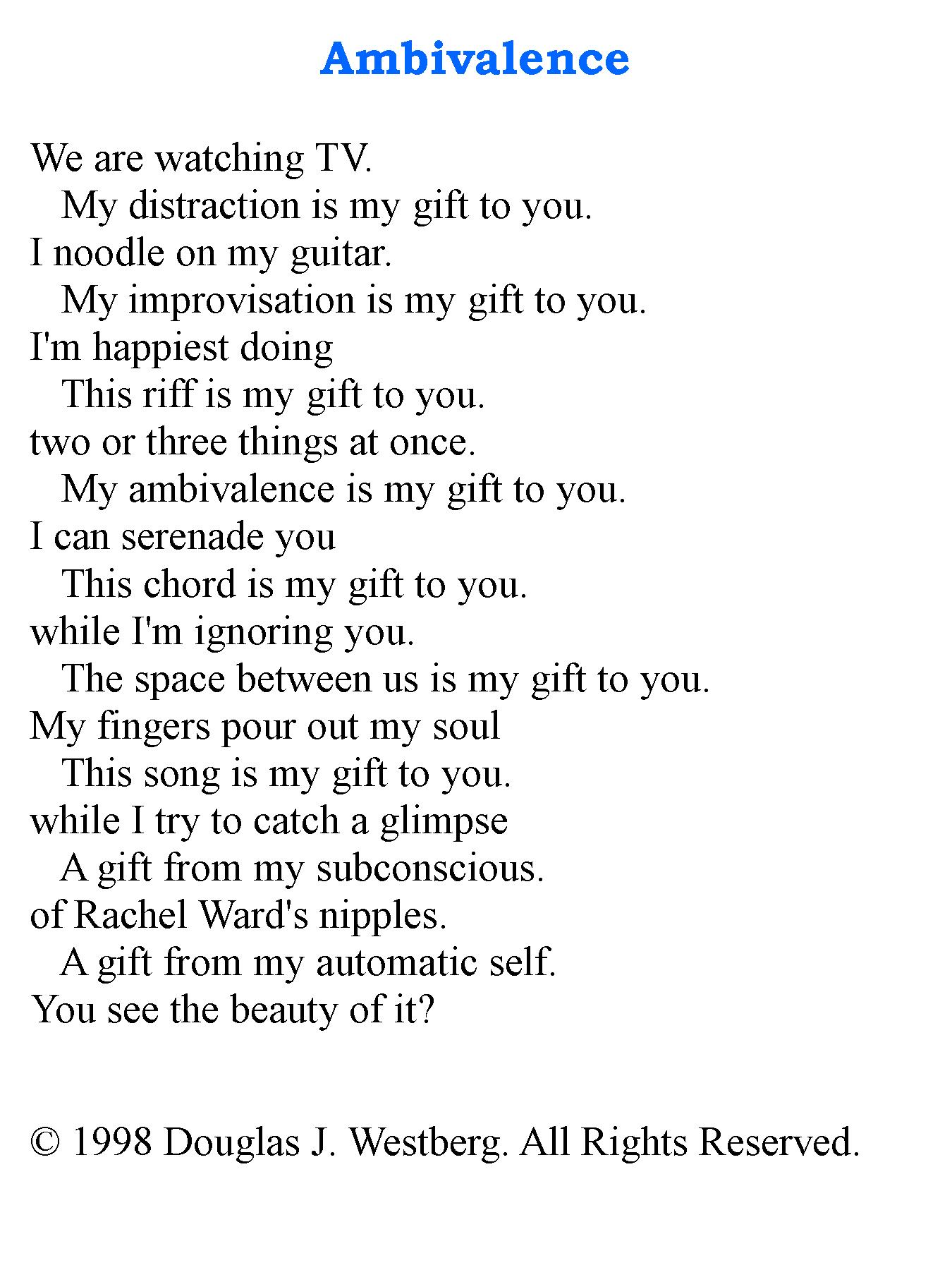
Interesting story: My good friend and colleague Susan Budig, who writes a column called Mindful Poetry, did a prompt asking for readers’ original forms. Respondents were instructed to submit at least two examples of poems in that form. I submitted the two you see below. Susan’s response was that she didn’t see how the two poems were the same form.
SunWinks! August 31, 2014: Cubism Isn’t Just For Squares
Dear SunWinkers:
Cubism is an artistic movement of the 1910’s and ‘20s exemplified by Picasso. The idea of cubism is to deconstruct the objective components of a subject and reassemble them in striking ways. So Picasso pulls out eyes and nose and breasts and contours and assembles them on the canvas as though he had turned around and thrown them over his shoulder like a bridal bouquet. The effect is to open the mind and force us to look at the inner structure of things without being seduced by phenomena like symmetry and photorealism.
So it is with cubist poetry, which breaks its subject matter down into discrete pieces and juxtaposes them in unusual ways, creating a nonlinear effect on the mind that would otherwise be inaccessible underneath layers of the familiar flow of meaning and language. Continue reading
 SunWinks!