Putting this up as an example for November 16th’s SunWinks! on neologisms. From Papa Doug’s Light Book of Little Verse.
Love, Doug
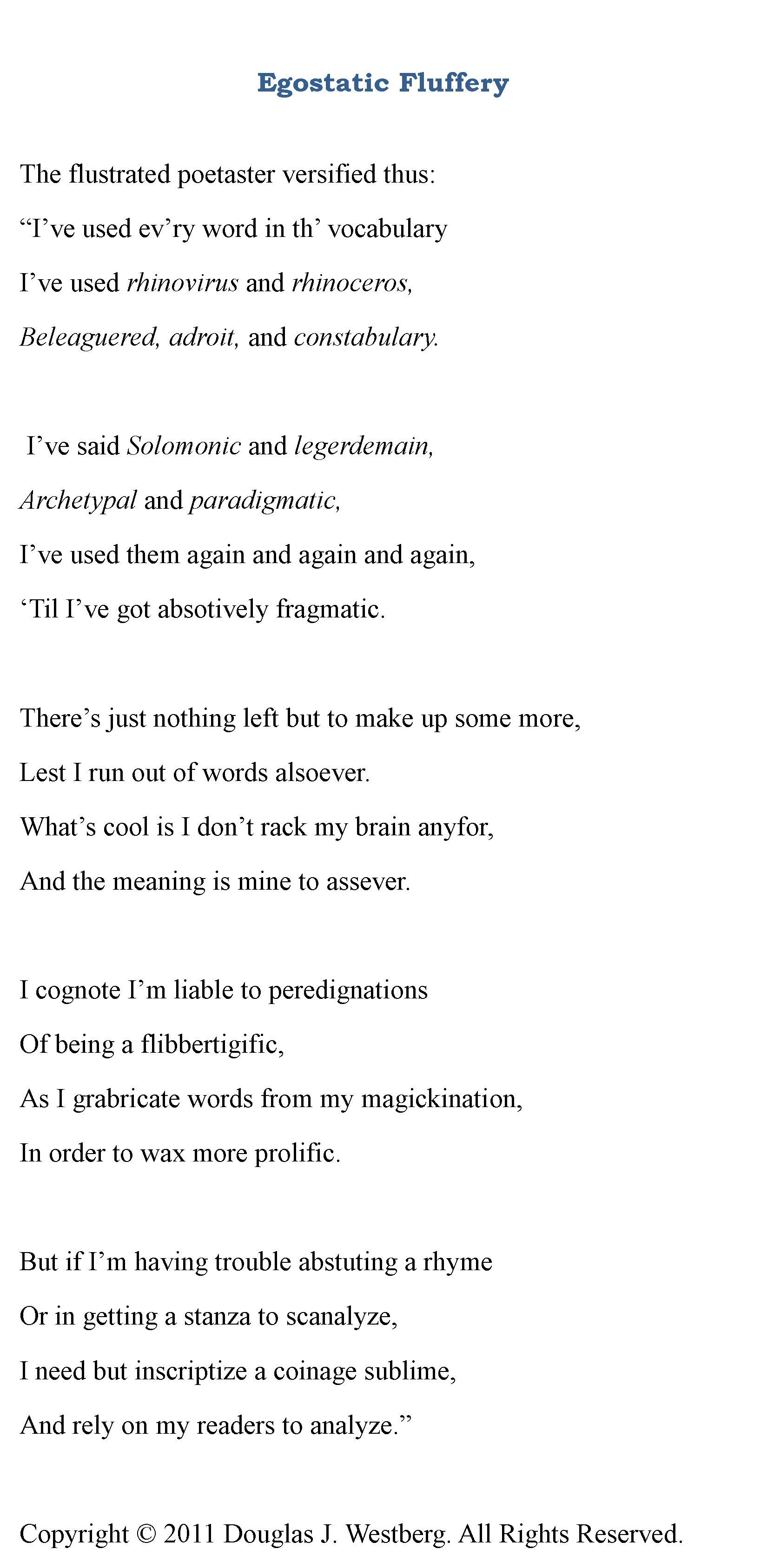

Putting this up as an example for November 16th’s SunWinks! on neologisms. From Papa Doug’s Light Book of Little Verse.
Love, Doug

This is a response to my prompt of tomorrow, October 26, 2014 (I actually wrote it a few weeks ago) on the topic of The Shadow Self.
Additionally, if I had titled this “Introspection,” then it would be a response to the October 19 prompt. But that gives away the metaphor, so that’s why I didn’t. But you might want to look at this from the standpoint of that earlier prompt.

A new poem, expressly written in response to my own prompt of this week:

I’m sending this to the Chicago Cubs broadcasters Len Kasper and Jim Deshaies. Len and J.D.: I think you’ll enjoy this. It’s a parody of James Whitcomb Riley’s “When the Frost Is On the Punkin.”
Best wishes, Doug Westberg.
[This is my copyrighted work, but I acknowledge submitting this gives you the right to use it any way you like.]
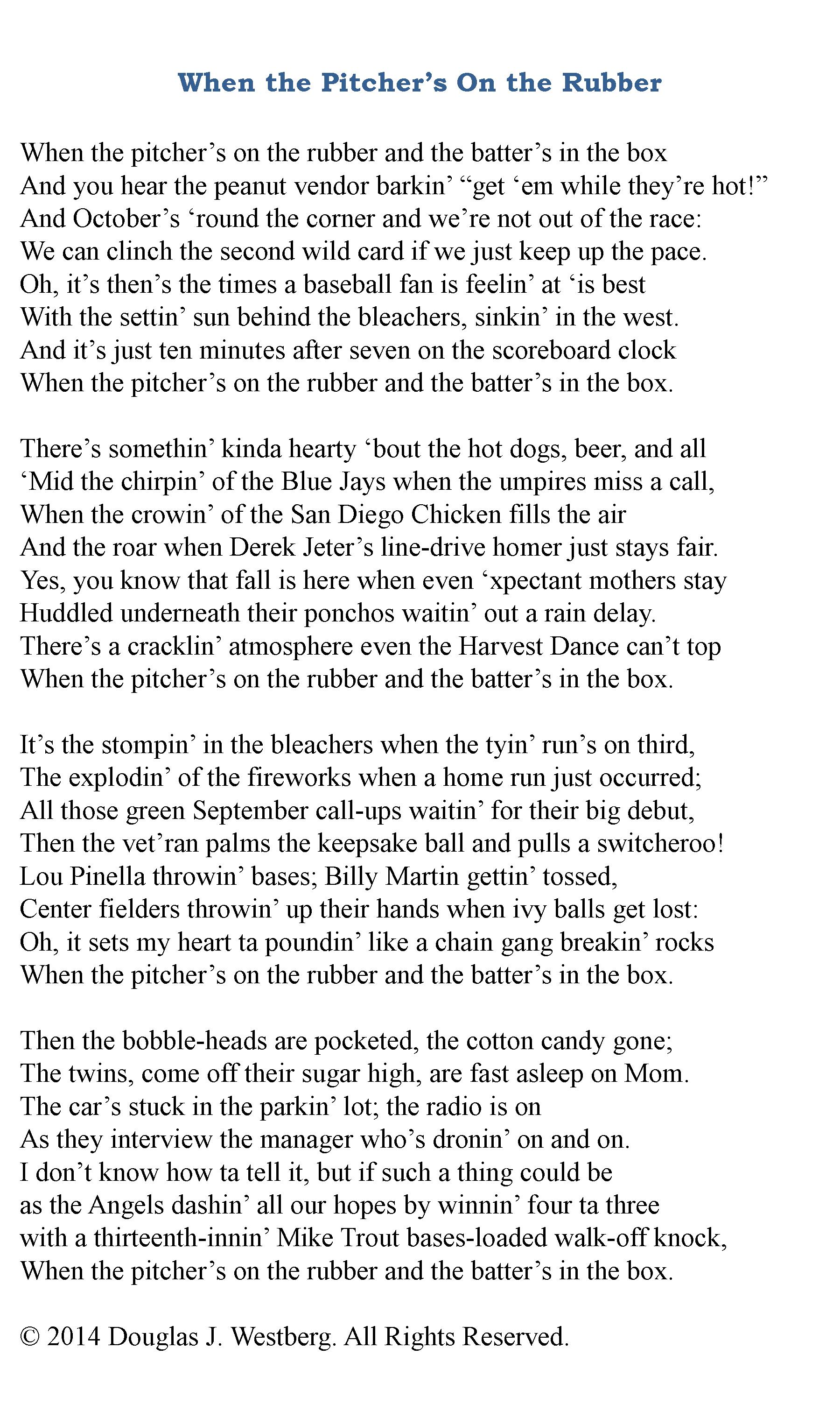
 Dear SunWinkers:
Cubism is an artistic movement of the 1910’s and ‘20s exemplified by Picasso. The idea of cubism is to deconstruct the objective components of a subject and reassemble them in striking ways. So Picasso pulls out eyes and nose and breasts and contours and assembles them on the canvas as though he had turned around and thrown them over his shoulder like a bridal bouquet. The effect is to open the mind and force us to look at the inner structure of things without being seduced by phenomena like symmetry and photorealism.
So it is with cubist poetry, which breaks its subject matter down into discrete pieces and juxtaposes them in unusual ways, creating a nonlinear effect on the mind that would otherwise be inaccessible underneath layers of the familiar flow of meaning and language. Continue reading
I’m normally very protective of my poetry, but I’m posting this one as text and protecting it with a Creative Commons License* in hopes you will share this with your communities so it can reach someone who needs to read it.
*You may copy and distribute it any way you like as long as you attribute it to me and don’t alter it.
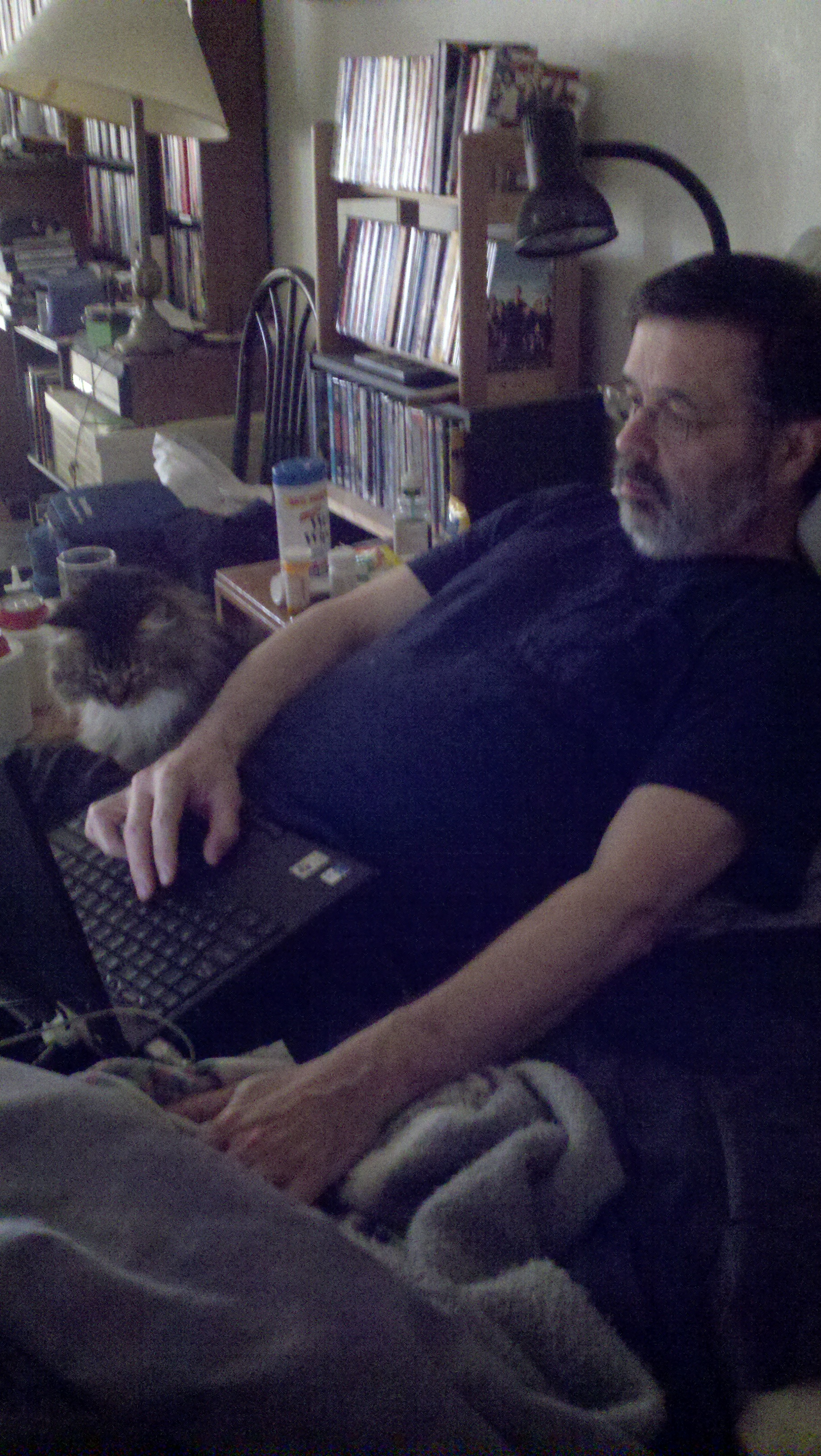
Serefina reads over my shoulder
My cat has a tumor under her eye.
It looks just like a ripe cranberry.
She’s seventeen years old,
eighty-five in human years.
Given her age,
even a biopsy would be risky.
So there’s not much to do but watch it grow.
My brother had Kaposi’s sarcomas
all over his face.
We went to the pizza parlor and the deli once.
He was totally unself-conscious
as were the food workers who
greeted him like an old friend.
My wife has a lump in her breast.
You can’t see it.
You can’t even feel it.
You wouldn’t know she had cancer to look at her.
She embraces it
as a source of blessings,
and it has been already,
only just embarking on her
twenty weeks of chemo.
She’ll be just fine,
but even so, she teaches me
how to embrace life.
My tumor is even less visible.
It’s a virtual tumor,
hidden in code amid ganglions of nerves.
It’s the voice in my head that
urges me to destroy myself,
the voice that says things like
What’s the use?
I can’t take one more day.
I need a fix.
I just want to die
or (on a good day)
I just want to sleep.
Back to my kitty:
she seems to be comfortable enough.
She still purrs
and eats
but she seems to sense her days are numbered,
and she responds by coming to me for love
and petting and skritching
every chance she gets,
like she wants to get the most out of life
while she can.
I used to let my daughters give her the attention.
Now my girls are grown up
and kitty and I are close as father and daughter.
We are treasuring each day we have left together.
I didn’t get enough time with Bob, but
unless something goes terribly wrong,
Carol and I will have another twenty years,
and we will treasure every day of that, too.
Because when it comes right down to it,
life is all about the skritch.
That’s what Carol and Serefina are teaching me.
And that voice in my head that wants me to die?
I don’t hear it much these days.
© 2014 Douglas J. Westberg. Please reblog, share, copy, distribute at will with appropriate attribution, but do not alter.

Virtual Tumor by Doug Westberg is licensed under a Creative Commons Attribution-NonCommercial-NoDerivatives 4.0 International License.
Dear SunWinkers!
William Stafford got up at four in the morning and wrote a poem every day. Robert Bly admired this and spent a year writing a poem a day, which he subsequently published as Morning Poems.
I’m just guessing here, but I don’t think you can write “The Waste Land” or “The Rime of the Ancient Mariner” every day. I was writing almost a poem a day a couple months ago, not in response to a challenge, just feeling fecund. Most are a page to a page-and-a-half long.
You get a feel for a certain length. The beginning is about half a page. The development is about half a page. And the ending is about half a page. You write the beginning, and after about 6-10 lines, it’s time to start thinking about getting into the development. It’s very much like the difference between sitting down to write a minuet or a sonata. Continue reading


 SunWinks!