SunWinks! February 15, 2015: Take a Tumble

SunWinksLogoDearest hardy, intrepid SunWinkers:

I frequently badger you to read your poetry aloud, and today’s column is no exception. Writing poetry without hearing what it sounds like is like studying a piano etude without touching the keyboard. For about a year, I’ve been making the rounds of poetry open mikes here in Vancouver USA and trying to be a good citizen of the poetry community. Reading your poems to an audience is so valuable, I just can’t recommend it highly enough!

Ghost Town Poetry open mike, February 12, 2015

You get to hear it aloud, hear yourself read it, see what the audience responds to and what falls flat and what flies over their heads. It builds confidence in public speaking and in yourself as an artist. I’ve grown immensely from doing this. Here’s a sample, from January’s Ghost Town Poetry open mike: http://youtu.be/4Cdg3JWppk4?t=20m

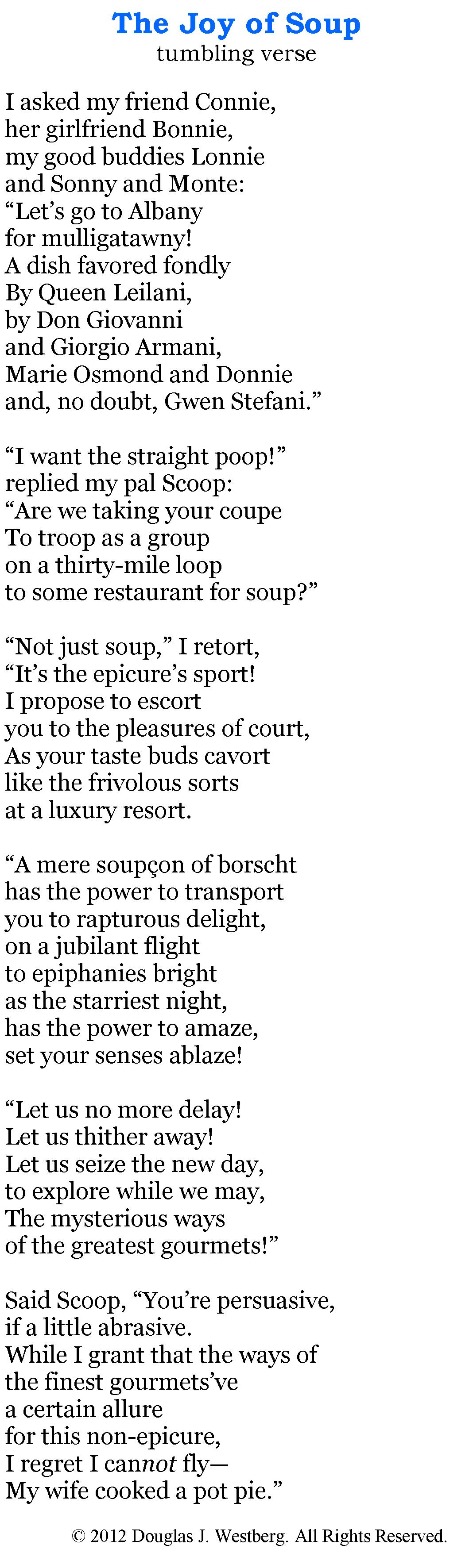
This week, we bounce from Metaphors 201 back to considerations of rhythm and sound. Today’s topic is Tumbling Verse a.k.a. Skeltonic Verse. It’s lots of fun and it’s a great way to experiment with rhythm, pace, diction, sonority, and phonetics. Continue reading

New Poem: Virtual Tumor

I’m normally very protective of my poetry, but I’m posting this one as text and protecting it with a Creative Commons License* in hopes you will share this with your communities so it can reach someone who needs to read it.

*You may copy and distribute it any way you like as long as you attribute it to me and don’t alter it.

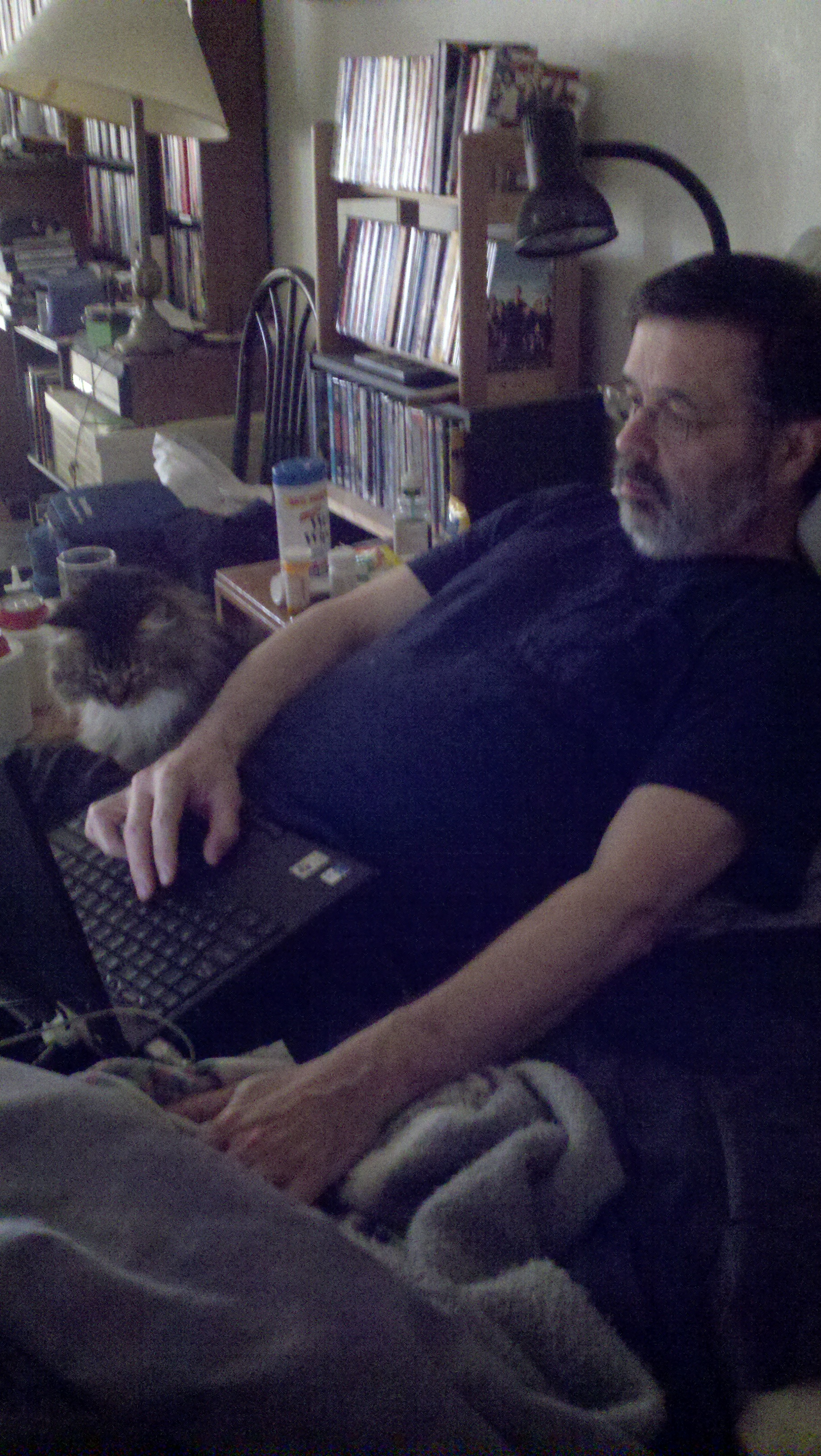
photo: kitty

Serefina reads over my shoulder

Virtual Tumor


My cat has a tumor under her eye.

It looks just like a ripe cranberry.

She’s seventeen years old,

eighty-five in human years.

Given her age,

even a biopsy would be risky.

So there’s not much to do but watch it grow.


My brother had Kaposi’s sarcomas

all over his face.

We went to the pizza parlor and the deli once.

He was totally unself-conscious

as were the food workers who

greeted him like an old friend.


My wife has a lump in her breast.

You can’t see it.

You can’t even feel it.

You wouldn’t know she had cancer to look at her.

She embraces it

as a source of blessings,

and it has been already,

only just embarking on her

twenty weeks of chemo.

She’ll be just fine,

but even so, she teaches me

how to embrace life.


My tumor is even less visible.

It’s a virtual tumor,

hidden in code amid ganglions of nerves.

It’s the voice in my head that

urges me to destroy myself,

the voice that says things like

What’s the use?

I can’t take one more day.

I need a fix.

I just want to die

or (on a good day)

I just want to sleep.


Back to my kitty:

she seems to be comfortable enough.

She still purrs

and eats

but she seems to sense her days are numbered,

and she responds by coming to me for love

and petting and skritching

every chance she gets,

like she wants to get the most out of life

while she can.

I used to let my daughters give her the attention.

Now my girls are grown up

and kitty and I are close as father and daughter.

We are treasuring each day we have left together.


I didn’t get enough time with Bob, but

unless something goes terribly wrong,

Carol and I will have another twenty years,

and we will treasure every day of that, too.


Because when it comes right down to it,

life is all about the skritch.

That’s what Carol and Serefina are teaching me.


And that voice in my head that wants me to die?

I don’t hear it much these days.


© 2014 Douglas J. Westberg. Please reblog, share, copy, distribute at will with appropriate attribution, but do not alter.

Creative Commons License
Virtual Tumor by Doug Westberg is licensed under a Creative Commons Attribution-NonCommercial-NoDerivatives 4.0 International License.

 

New Story: Shear Coincidence

Shear Coincidence


A Zen monk was bicycling through a residential neighborhood in East Vancouver, Washington. He was pedaling along a random side street, miles from home, as a consequence of meandering around checking out garage sales, when by chance he came upon a man pinned underneath his lawn tractor beside the curb in front of his home. The monk took in the scene and asked himself, “Is this really happening?” He raced up to the man and set his bicycle down.

“Are you all right?” he asked the man, a typically but not grossly overweight Caucasian man in his fifties or sixties, evidently the homeowner. The tractor was on its side, half off the curb; the man was lying on his side with his legs underneath the steering wheel. He was struggling with the tractor, but in his position, could not budge the tractor or slide out from under the steering column.

John Deere lawn tractor“I just need to lift this off me,” he replied. The monk lifted the tractor by the steering wheel and with some effort wrested it off the man’s legs.

“Are you okay?” the monk asked again, concerned the man’s legs might have gotten crushed or something.

“Yes, I’m fine,” the man said, “can you help me up?” The man extended his hand and the monk helped him to his feet. It took somewhat more effort than lifting the tractor, actually, but between the two of them, they managed it. “Thank you very much,” said the man. Continue reading

SunWinks! July 27, 2014: Ars Poetica

Dear SunWinkers:

SunWinksLogoThere are two ways of classifying poems: One is by form: haiku, sonnet, villanelle, quatrain, rubaiyat, cubist, concrete, etc. The other is by purpose: elegy, ode, pastoral, epic, love poem, etc. One of the latter is, I suppose, inevitable: sooner or later, a dedicated poet of any accomplishment will feel the impulse to write about the poetic process, what a poem is, or what it should be. Such a poem is referred to as an ars poetica, which is Latin for “the art of poetry.” Possibly the most famous is Archibald MacLeish’s “Ars Poetica” :

(…)
A poem should be equal to:
Not true.

For all the history of grief
An empty doorway and a maple leaf.

For love
The leaning grasses and two lights above the sea—

 A poem should not mean
But be.

  Continue reading

SunWinks! July 20, 2014: Where Is Thy Sting?

Dear SunWinkers!

Out, out, brief candle!
Life’s but a walking shadow, a poor player
That struts and frets his hour upon the stage
And then is heard no more.

            Shakespeare, Macbeth


SunWinksLogoI find myself being rather emotional these days. Last week, I spent four days in bed with the chest flu. This sort of inactivity and helplessness is very problematical for me as a trigger for depression. After another week, I’m still not my better self in terms of energy and industry.

Add to this… Continue reading

SunWinks! July 6, 2014: H.M.S. Metaphor Sails Again

SunWinks! July 6, 2014: The H.M.S. Metaphor Sails Again

Dear SunWinkers!

A tasty confection the metaphor,
As sweet to an ode as a petit four,
A friend to the scribe,
Which, aptly applied,
Your poem will be so much the better for.

Last week, we introduced the idea that our language is built through metaphor. There were so many great stories to choose from, and all from just the one book: Loose Cannons, Red Herrings, and Other Lost Metaphors by Robert Claiborne [New York: W.W. Norton & Co., 1988]. (I have half a dozen others.) So this week, I’m just going to throw out a few more word stories and let you either work on last week’s prompt, or a completely different prompt which I’ve supplied below.

Annie Oakley

Phoebe Anne Oakley Mozee, a.k.a. Annie Oakley, gave shooting exhibitions in Buffalo Bill’s Wild West Show in the late 1800s. One of her most famous tricks was to throw a playing card into the air and shoot a hole in it. In that era, “comps,” complimentary tickets for theater or sporting events, had holes punched in them to prevent them being resold. Ban Johnson, founding president of the American League, took to calling such comps “Annie Oakleys,” and the name stuck. Later on, the nickname came to refer to other freebies, such as a walk in baseball. Alas, the nickname is virtually forgotten today.

Have you ever thought about where the name “cockpit” came from? As you might guess, it’s just what it looks like, a reference to the small sunken pits in which cockfights were held. A metaphorical cockpit is any small space in which intense fighting takes place, hence its application to the pilot’s compartment of a fighter plane. Continue reading