Here’s one of my ars poeticas, written a couple years ago for a prompt.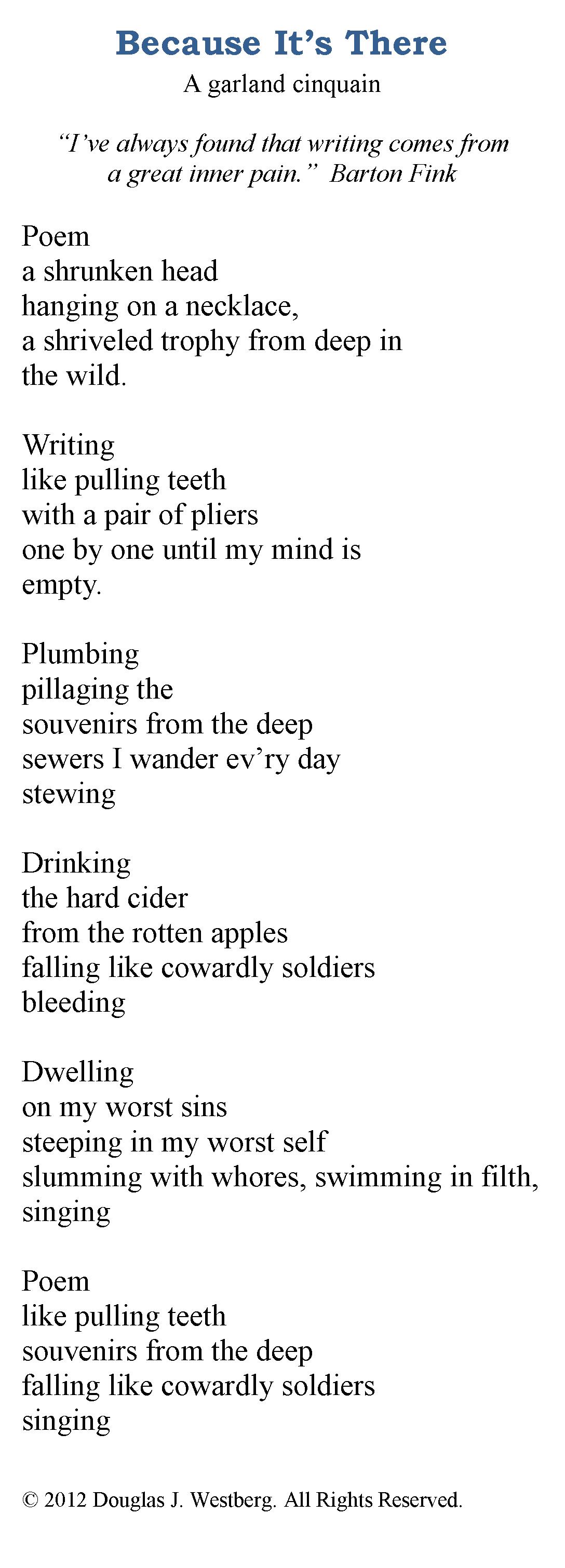
This is written in the “garland cinquain” form. Forms of this complexity Continue reading
Here’s one of my ars poeticas, written a couple years ago for a prompt.
This is written in the “garland cinquain” form. Forms of this complexity Continue reading
Dear SunWinkers:
 There are two ways of classifying poems: One is by form: haiku, sonnet, villanelle, quatrain, rubaiyat, cubist, concrete, etc. The other is by purpose: elegy, ode, pastoral, epic, love poem, etc. One of the latter is, I suppose, inevitable: sooner or later, a dedicated poet of any accomplishment will feel the impulse to write about the poetic process, what a poem is, or what it should be. Such a poem is referred to as an ars poetica, which is Latin for “the art of poetry.” Possibly the most famous is Archibald MacLeish’s “Ars Poetica” :
(…)
A poem should be equal to:
Not true.
For all the history of grief
An empty doorway and a maple leaf.
For love
The leaning grasses and two lights above the sea—
A poem should not mean
But be.
For those of you, all three of you, who are following my every post with bated breath, this was my initial attempt to write a modern-style* poem about death in response to my own prompt of Sunday. It wasn’t the poem I was trying to write (I succeeded on the second try). Comments welcome.
*When I say “modern-style,” it sounds a little silly, as though I were saying “new-fangled.” What I mean, precisely, is poetry in English in the period 1940-2000.
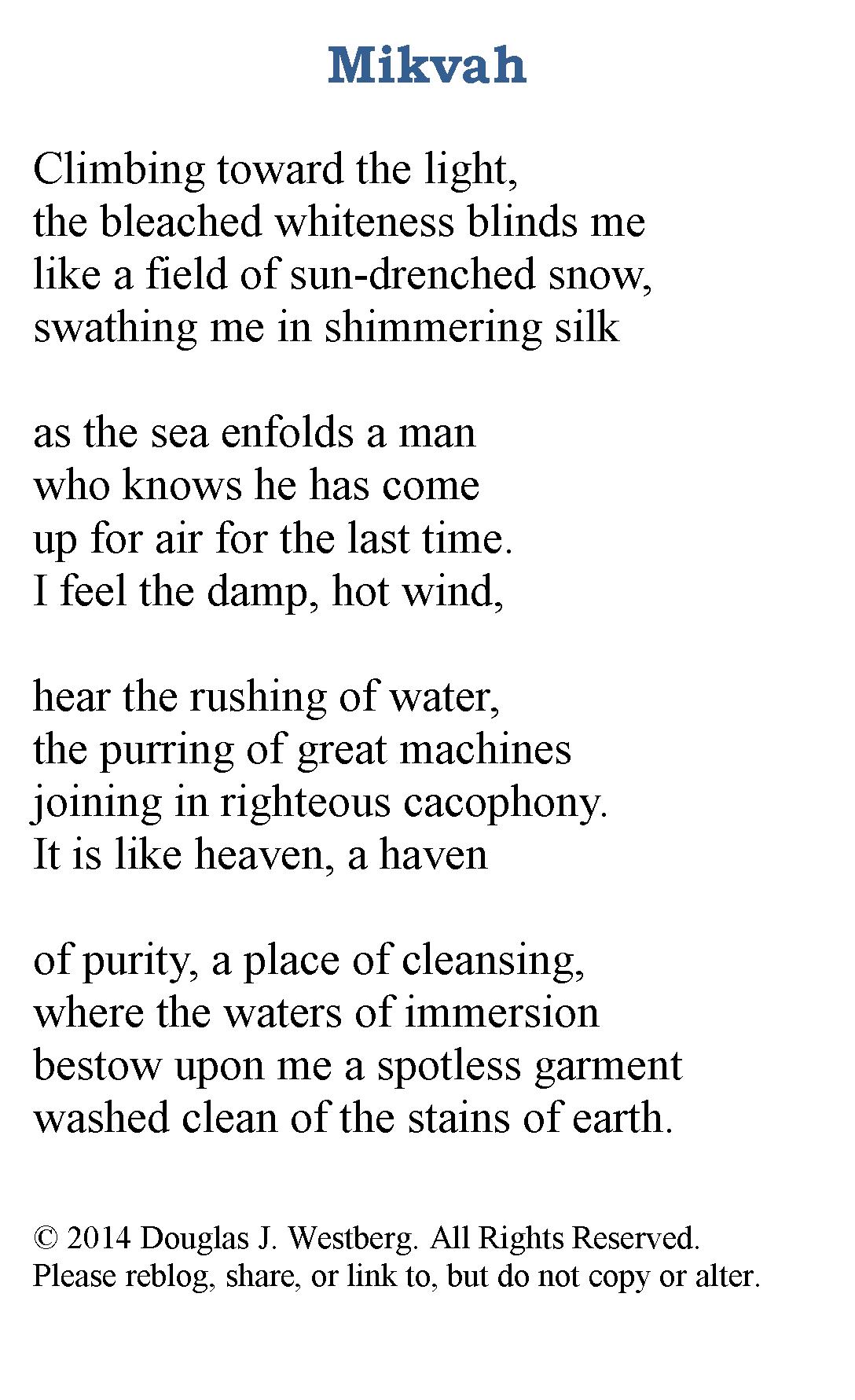
Update: I’ve been contemplating this some more and decided to rename it “Mikvah.” Mikvah is the Jewish purification ritual of immersion in water.
Dear SunWinkers!
Out, out, brief candle!
Life’s but a walking shadow, a poor player
That struts and frets his hour upon the stage
And then is heard no more.
Shakespeare, Macbeth
I find myself being rather emotional these days. Last week, I spent four days in bed with the chest flu. This sort of inactivity and helplessness is very problematical for me as a trigger for depression. After another week, I’m still not my better self in terms of energy and industry.
Add to this… Continue reading
Burnt, I circumambulate my maisonette
in protozoic stupor,
mulling hollow images formulated
from the sawdust
of etherised metaphysics.
Outside the window-panes,
sun-kist hyacinths
dance with the arboreal shadows
falling across my tea and marmalade,
but I conjure only
broad-bottomed sea-girls
in ragged trousers.
Empty, I whimper
like a fugitive.
Empty
is the cruellest word.
© 2014 Douglas J. Westberg. All Rights Reserved. Please share, link to, reblog, but do not copy or alter.
The prompt (adapted from The Poet’s Companion [Kim Addonizio and Dorianne Laux; New York: W.W. Norton, 1997]):
Skim several books of poetry by, perhaps, your favorite poets. Without paying too much attention to the context, jot down words that strike your fancy. Go through the resulting list and pick out about twenty of these. Fashion them into a poem, using these words and as few other words as possible.
In this case, I started with a list of twenty words exclusively from T.S. Eliot poems. (I added “burnt” and “tea” as I went along.)
We’ve been talking about metaphor in our language (that’s how it’s built) and our poetry (it wouldn’t be very poetic without it). Metaphors—and successful poetry—make us look at things in new ways by making fresh connections among diverse ideas.
An extended metaphor is a comparison that is carried out through an extended part or the entire length of a work. Some writers say it is synonymous with allegory. I think they are two different things, but I don’t have the energy to belabor the point here.
Here is a tiny sample of poems which use extended metaphors. Browse your favorite anthology to find many more. They shouldn’t be too hard to pick out. In fact, it occurs to me this would be a fabulous exercise!
Dear SunWinkers!
A tasty confection the metaphor,
As sweet to an ode as a petit four,
A friend to the scribe,
Which, aptly applied,
Your poem will be so much the better for.
Last week, we introduced the idea that our language is built through metaphor. There were so many great stories to choose from, and all from just the one book: Loose Cannons, Red Herrings, and Other Lost Metaphors by Robert Claiborne [New York: W.W. Norton & Co., 1988]. (I have half a dozen others.) So this week, I’m just going to throw out a few more word stories and let you either work on last week’s prompt, or a completely different prompt which I’ve supplied below.

Annie Oakley
Phoebe Anne Oakley Mozee, a.k.a. Annie Oakley, gave shooting exhibitions in Buffalo Bill’s Wild West Show in the late 1800s. One of her most famous tricks was to throw a playing card into the air and shoot a hole in it. In that era, “comps,” complimentary tickets for theater or sporting events, had holes punched in them to prevent them being resold. Ban Johnson, founding president of the American League, took to calling such comps “Annie Oakleys,” and the name stuck. Later on, the nickname came to refer to other freebies, such as a walk in baseball. Alas, the nickname is virtually forgotten today.
Have you ever thought about where the name “cockpit” came from? As you might guess, it’s just what it looks like, a reference to the small sunken pits in which cockfights were held. A metaphorical cockpit is any small space in which intense fighting takes place, hence its application to the pilot’s compartment of a fighter plane. Continue reading
Dear SunWinkers!
Where are all the haikais? I expected to be inundated with poo-kus. Well, there are no deadlines at SunWinks! Get them in when you can—it’s never too late.
Important note: if SunWinks! and Writing Essential Group are to survive and thrive, it is imperative that you do your part by sharing these columns with your communities on WordPress, Facebook, Twitter, StumbleUpon, Pinterest, Google+, whatever. We can’t build a community without your help.
On to today’s topic: Metaphor. That stampeding of hooves you hear is the self-described “non-poets” running as fast as they can in the other direction. I get the same reaction every time I mention that word: “I just don’t understand poetry.”
The inescapable fact is that you pretty much cannot write a poem without using metaphor in some form or fashion. But here’s the thing: you also pretty much can’t talk without metaphor. Metaphor is one of the building blocks of language. Teachers and public speakers know the value of metaphor. Our speech is chock full of metaphor whether we’re aware of it or not. “Stampeding of hooves” above is a metaphor—so is “running as fast as they can etc.”. Metaphors are the stock in trade, the coin of currency (there are two more metaphors!), of any writer who strives to be more colorful than dishwater (that’s a simile).
Dear SunWinkers!
Happy Father’s Day! I just want to say that it’s been an unalloyed privilege to live with my four children for the 28 years from when I married Nevada’s mother to when Hannah moved out. They are four of the sharpest, brightest, most beautiful and interesting human beings I’ve ever met. Yes, they could be infuriating. Yes, the challenges were overwhelming at times. But I treasure every single second because all of that made those children the people of whom I am so deeply proud and admiring today.
I’m on a new kick right now, taking pictures and writing haiku to go with them. Did you notice? This is not my first haiku kick. Actually, I think it’s my second. During my first poetry phase (c. 1998-2001), I wrote one haiku, and that was a spoof. My first haiku kick was less than a year ago—you can see them in my new book, Papa Doug’s Light Book of Little Verse.
Kick #2 started a week ago on a bike ride. I was greeted with an extraordinary sky as I was coming out of Value Village thrift store. I was greeted with another stunning vista halfway home. Thanks to my smartphone camera, these became SkyKu 1 and SkyKu 2. I love taking pictures because it’s such an undepressed thing to do. You have to have a sense of inquisitiveness and wonder, and to want to capture the image for future enjoyment and reflection. For me, it’s not just a pleasure, it’s a bellwether.
Going back to a picture, especially one I took myself, and writing a haiku, exploring the mystery and wonder of what I was looking at, is an additional pleasure. In fact, I have little interest in writing haiku about a picture I did not take. The point of haiku is to reflect on one’s own experience, on one’s own tiny movement of the soul produced from one’s identification with the natural.
Dear SunWinkers:
We’ve been talking about a whole ‘nother aspect of the music of poetry: figures of speech, a.k.a. rhetorical figures. Rhetorical figures are ways to manipulate the rhythms of speech to give your poetry or oratory or prose rhythm, momentum, and impact. I just used three of them.
“a whole ‘nother” is a tmesis: splitting a word in two, usually to put another word in between.
“…rhetorical figures. Rhetorical figures…” is an anadiplosis: repeating a word or phrase from the end of a clause or sentence at the beginning of the next.
“poetry or oratory or prose” is polysyndeton: using extra conjunctions (that is, “or” instead of a comma between “poetry” and “oratory”.
We can’t cover all of the 60 figures of speech described in Figures of Speech: 60 Ways to Turn a Phrase by Arthur Quinn [Salt Lake City: Gibbs M. Smith Inc., 1982]. If you want to get all obsessive over this, I mean, if you want to make a methodical study of this topic, you can get ahold of Quinn’s book or go to a wonderful website called The Forest of Rhetoric http://rhetoric.byu.edu/ which describes many times 60 rhetorical figures.
Many of the figures we’ve looked at are repetitive figures, and I did want to cover a few more of those. The reason is that they are pretty easy to understand, and to get a feeling for how they can improve the rhythm and music of your poetry.
So far, we’ve covered these:
Epistrophe is repeating a word or words at the end of a succession of phrases: “of the people, by the people, for the people” Abraham Lincoln. Continue reading

