SunWinks! September 21, 2014: Playing the Field

Dear SunWinkers!SunWinksLogo

“The time has come,” the Walrus said,
“To talk of many things:
Of shoes–and ships–and sealing-wax–
Of cabbages–and kings–
And why the sea is boiling hot–
And whether pigs have wings.”
Lewis Carroll


Well, I got Len to write a poem, so pigs must have wings…..

Anyway, poetry is many things, and consists of many things, and we are going to talk about one of them. Today I want you to think about the placement of the words on the page.

Now, poetry is an oral medium. A good poem must be read out loud, both by the poet in the process of composition, and by the discerning reader.

It follows that the organization of a poem affects how it sounds when read out loud. When it is written in a fixed form, such as a ballad, the form is imposed on the content, and the content must be manipulated to fit the structure. Therefore, much of the music of the poem comes from the superimposed formal structure.

The emergence of open form (or free verse) spearheaded by Ezra Pound and William Carlos Williams in the 1940s is based on the idea that the form of a poem ought to grow organically from the thoughts, words, and breathing of the poet. Pound said that poets should “compose in the sequence of the musical phrase, not in the sequence of a metronome.”

Continue reading

SunWinks! September 14, 2014: Gently Down the Stream

Dear SunWinkers:SunWinksLogo

Years ago, I was struggling with deep depression, divorce, custody battle, blah blah blah. I started writing poetry as a form of therapy. I would usually begin by doing some automatic writing in my journal, just writing the next word that came into my head without thinking about it, and before you know it, there I would be, writing a poem.

Not too long ago, I wrote an experimental poem, just a goof, really, called “Listening In.” The idea was to “record” (not literally, the poem was a deliberate composition) what I heard and saw and what was going through my mind as I watched a Chicago White Sox broadcast with Ken “Hawk” Harrelson and Steve Stone. The poem leaps from inner thought to external action to thought to action to thought to action.

So, in a way, this is what is called stream of consciousness writing. Stream-of-consciousness writing differs from automatic writing in that the author composes the stream of thought that is putatively going through the character’s head. S-o-c writing eschews punctuation and sentence structure, hurtling along from thought to fragmentary thought. James Joyce, Virginia Woolf, William Faulkner, and Jack Kerouac are notable practitioners. Continue reading

SunWinks! September 7, 2014: Give ‘Em The Fast Shuffle

Dear SunWinkers:

SunWinksLogo How’s the wife, you ask? Get it from the horse’s mouth at http://carollineswords.wordpress.com ! We went to Carol’s hairdresser today and—well, I’ll let her tell you.

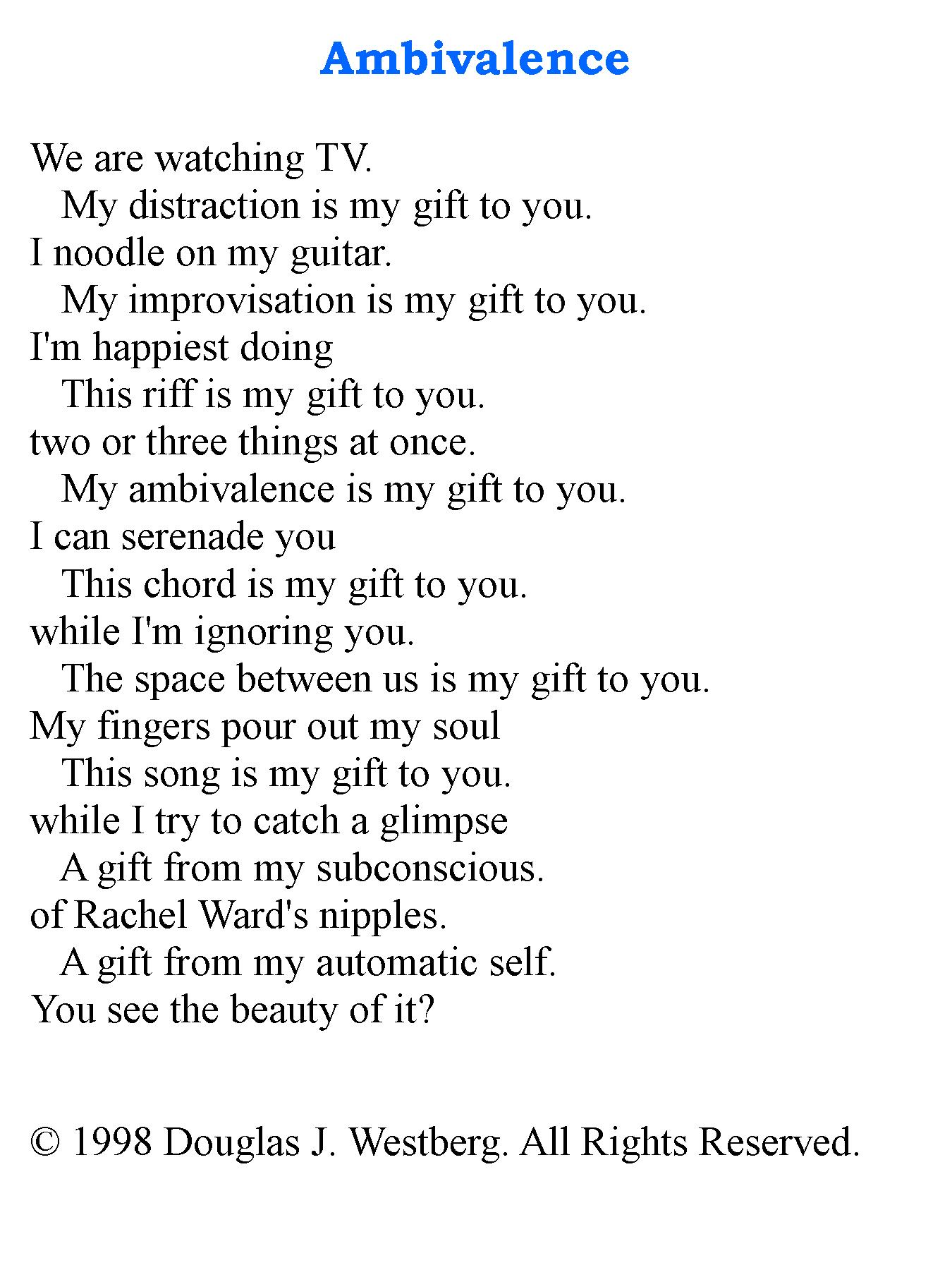
Interesting story: My good friend and colleague Susan Budig, who writes a column called Mindful Poetry, did a prompt asking for readers’ original forms. Respondents were instructed to submit at least two examples of poems in that form. I submitted the two you see below. Susan’s response was that she didn’t see how the two poems were the same form.

Poem: Ambivalence Continue reading

SunWinks! August 31, 2014: Cubism Isn’t Just For Squares

SunWinksLogoDear SunWinkers:

Cubism is an artistic movement of the 1910’s and ‘20s exemplified by Picasso. The idea of cubism is to deconstruct the objective components of a subject and reassemble them in striking ways. So Picasso pulls out eyes and nose and breasts and contours and assembles them on the canvas as though he had turned around and thrown them over his shoulder like a bridal bouquet. The effect is to open the mind and force us to look at the inner structure of things without being seduced by phenomena like symmetry and photorealism.

So it is with cubist poetry, which breaks its subject matter down into discrete pieces and juxtaposes them in unusual ways, creating a nonlinear effect on the mind that would otherwise be inaccessible underneath layers of the familiar flow of meaning and language. Continue reading

SunWinks! August 24, 2014: Keeping It Short

SunWinksLogoDear SunWinkers!

William Stafford got up at four in the morning and wrote a poem every day. Robert Bly admired this and spent a year writing a poem a day, which he subsequently published as Morning Poems.

 I’m just guessing here, but I don’t think you can write “The Waste Land” or “The Rime of the Ancient Mariner” every day. I was writing almost a poem a day a couple months ago, not in response to a challenge, just feeling fecund. Most are a page to a page-and-a-half long.

You get a feel for a certain length. The beginning is about half a page. The development is about half a page. And the ending is about half a page. You write the beginning, and after about 6-10 lines, it’s time to start thinking about getting into the development. It’s very much like the difference between sitting down to write a minuet or a sonata. Continue reading

Sunwinks! August 17, 2014: Listing to Port

SunWinksLogoDear SunWinkers!

I would sure love to see some of you so-called non-poets, especially my fellow editors, take a crack at a list poem before we leave the topic. If you can make out a grocery list, you can write a list poem. It’s fun! You’ll be the envy of your friends! You can add “Poet” to your business card!

Review the examples in last week’s column. You can see the possibilities are endless, and there’s no way to “get it wrong.” Bottom line: if you say it’s a poem, it’s a poem. If there’s a list involved, it’s a list poem!

  • The list doesn’t have to be the whole poem
  • The list items don’t have to be single words
  • The list items don’t have to be all in the same form
  • And if that weren’t enough,
  • The list items can be interrupted with parenthetical phrases

So I expect to see lots of list poems next week. There’s just no excuse!

Continue reading

SunWinks! August 3, 2014: Renaming the World

Dear SunWinkers:

The other day, Carol found a lump under her armpit the size of a small lime. We thought perhaps it was a swollen lymph node from her recent bout with the flu. Her ob-gyn brought her in post haste for a mammogram. They discovered a lump in her breast, brought her back the next day for a biopsy. Two days later, the result was in. It’s cancer. It’s very early, will probably not require a mastectomy, and will certainly not kill her. She got on Medicare in April, which is the best possible news, insurance-wise. We are also grateful for the state of cancer treatment today. She will go to a sophisticated cancer treatment center literally right around the corner. Finally, we are particularly grateful to that lymph node, and I plan to write a big check to its favorite charity very soon.

Naturally, I wrote a poem. As I’ve mentioned recently, poetry isn’t just a creative outlet; it is a way to work things out, to put words to inchoate thoughts and emotions, to shed light on the unfathomable, to make connections as an anodyne to the randomness of reality.

Poets are also in the business of turning things upside down. Poet Adrienne Rich says: “If the imagination is to transcend and transform experience it has to question, to challenge, to conceive of alternatives, perhaps to the very life you are living at that moment. You have to be free to play around with the notion that day might be night, love might be hate; nothing can be too sacred for the imagination to turn into its opposite or to call experimentally by another name. For writing is renaming.”

In his book Why Poetry Matters [New Haven, Ct: Yale Univ. Press, 2008], Jay Parini states, “Poetry, therefore, assists readers subjected to violent realities by opening their minds to fresh ways of thinking. Most famously, [Wallace] Stevens defines poetry as ‘a violence from within that protects us from a violence without. It is the imagination pressing back against the pressure of reality. It seems, in the last analysis, to have something to do with our self-preservation; and that, no doubt, is why the expression of it, the sound of its words, helps us to live our lives.’”

“Lumps” is a straightforward piece, easy to see how it is the imagination “pushing back against reality,” and to that end, an attempt to turn the idea of beauty upside down from the ideal of Hollywood and Madison Avenue with which the culture is so saturated.

Poem: Lumps

 The Prompt

Write a poem about something you don’t understand, can’t get your head around. Try to find some images (think small), or begin by writing down random words that come to mind on the subject. From those notes, perhaps something will emerge that promises to give you some sort of handle or angle on a small piece of the puzzle. Begin to write about that, and don’t try to cover too much ground. If a poem results, fine, otherwise, just tell us about the process and whether it gave you any new insights.

Alternate Prompt

Write a love poem. Begin by writing down a number of interesting things about the object of your love, things that would not ordinarily go into a conventional love poem. Then go from there. Write it in the second person, like an ode, addressing the object of love, as I’ve done in “Lumps.”

Post your response on your blog. If it’s a WordPress blog, tag it WeSun. Or put it in a Note on Facebook or some such functionality, something you can link to.

Then comment to this post with the link to your response.

I reblog this at WritingEssentialGroup.com (you should be following that blog, too) and will list and link to your responses there. I will also comment on all responses.

Love,

Doug

© 2014 Douglas J. Westberg.

 

SunWinks! July 27, 2014: Ars Poetica

Dear SunWinkers:

SunWinksLogoThere are two ways of classifying poems: One is by form: haiku, sonnet, villanelle, quatrain, rubaiyat, cubist, concrete, etc. The other is by purpose: elegy, ode, pastoral, epic, love poem, etc. One of the latter is, I suppose, inevitable: sooner or later, a dedicated poet of any accomplishment will feel the impulse to write about the poetic process, what a poem is, or what it should be. Such a poem is referred to as an ars poetica, which is Latin for “the art of poetry.” Possibly the most famous is Archibald MacLeish’s “Ars Poetica” :

(…)
A poem should be equal to:
Not true.

For all the history of grief
An empty doorway and a maple leaf.

For love
The leaning grasses and two lights above the sea—

 A poem should not mean
But be.

  Continue reading

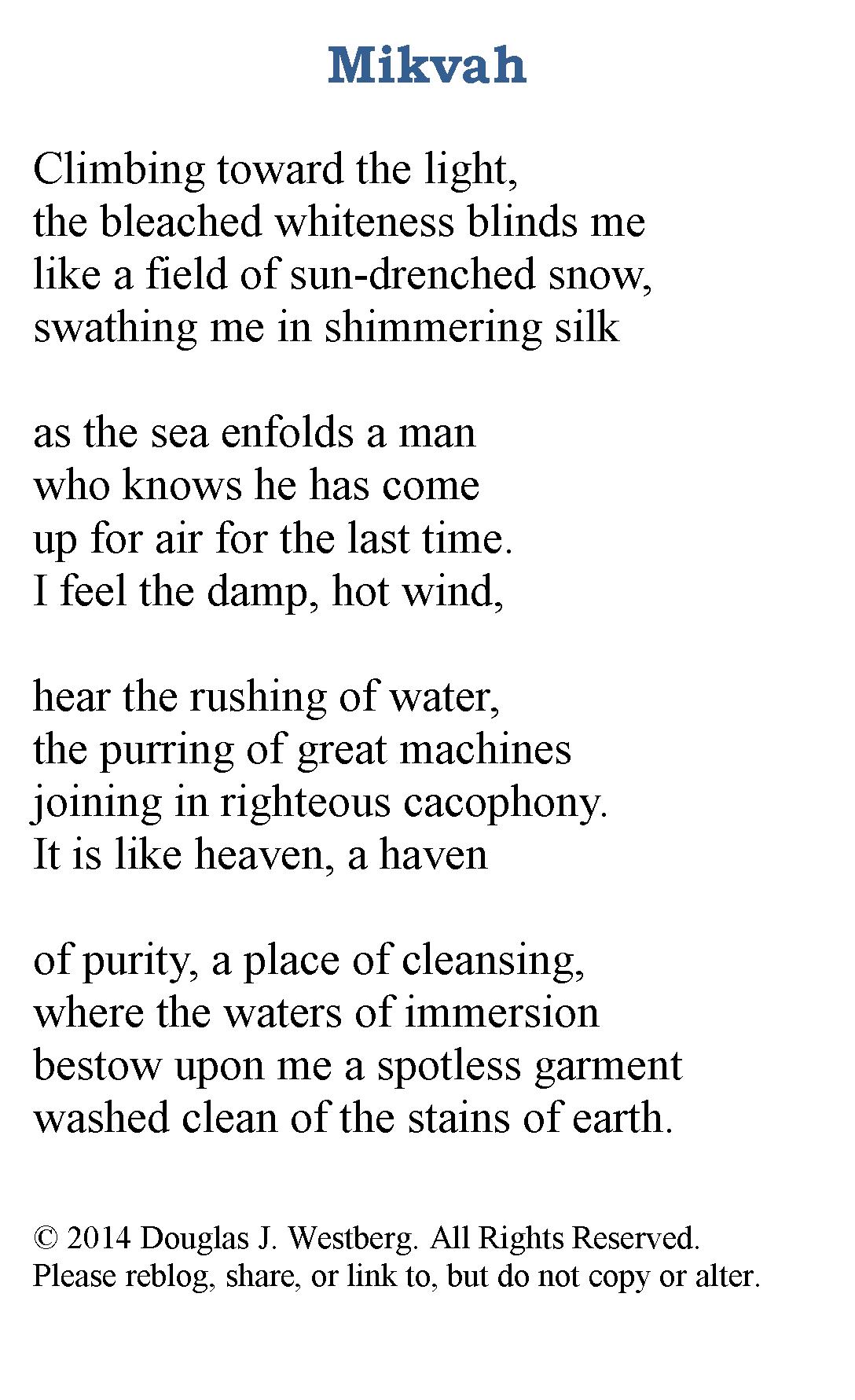
New Poem: Mikvah (formerly: Epiphany)

For those of you, all three of you, who are following my every post with bated breath, this was my initial attempt to write a modern-style* poem about death in response to my own prompt of Sunday. It wasn’t the poem I was trying to write (I succeeded on the second try). Comments welcome.

*When I say “modern-style,” it sounds a little silly, as though I were saying “new-fangled.” What I mean, precisely, is poetry in English in the period 1940-2000.

Update: I’ve been contemplating this some more and decided to rename it “Mikvah.” Mikvah is the Jewish purification ritual of immersion in water.

Mikvah

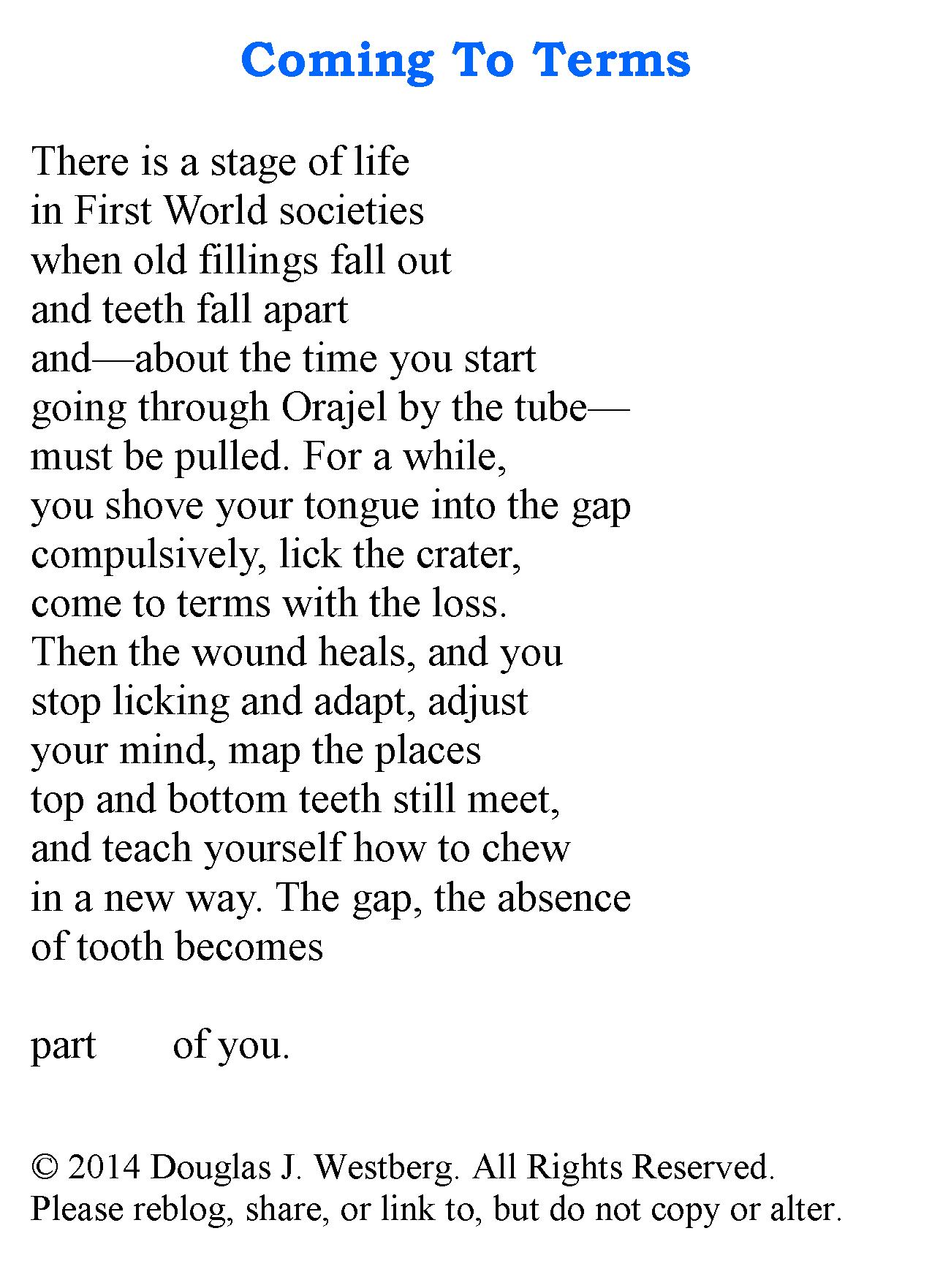
New Poem: Coming To Terms

Gentle Reader:

This is my response to my own prompt of yesterday. It took me two tries, interestingly. The first try turned into a different poem. I’ll post it later in the week.

This is what I meant by approaching the topic obliquely (from the side), metaphorically,  and on a small scale, more or less in the manner of William Carlos Williams and the other poets I cited in the column. This is but one approach; there are many others. Irina has taken a rather more sweeping and literal approach to the prompt and written a beautiful poem.

Coming To Terms