SunWinks! August 10, 2014: Check It Twice

SunWinksLogoDear SunWinkers:

Reflexive Pronoun Error of the Week:

Illinois man ‘showing off’ shotgun to friends fatally shoots self in head to prove it is empty.


Now on to this week’s column:


You make them to take to the grocery store…

You make them to do your Christmas shopping…

You make them to keep tabs on your money…

What are we talking about?

Duct Tape Wallets, of course!


I’m kidding. We’re talking about…


Lists

There’s a form of poetry called list poetry, also known as the catalogue poem, that goes back many centuries. The ancient list poems served as mnemonic devices: Polynesian list poems, for example, helped the islanders remember the names of all the different Polynesian islands. What amounts to list poetry can be found in Whitman’s Leaves of Grass, Homer’s Iliad, and it would not be stretching the point too much to include the genealogy in Matthew 1. Continue reading

New Story: Shear Coincidence

Shear Coincidence


A Zen monk was bicycling through a residential neighborhood in East Vancouver, Washington. He was pedaling along a random side street, miles from home, as a consequence of meandering around checking out garage sales, when by chance he came upon a man pinned underneath his lawn tractor beside the curb in front of his home. The monk took in the scene and asked himself, “Is this really happening?” He raced up to the man and set his bicycle down.

“Are you all right?” he asked the man, a typically but not grossly overweight Caucasian man in his fifties or sixties, evidently the homeowner. The tractor was on its side, half off the curb; the man was lying on his side with his legs underneath the steering wheel. He was struggling with the tractor, but in his position, could not budge the tractor or slide out from under the steering column.

John Deere lawn tractor“I just need to lift this off me,” he replied. The monk lifted the tractor by the steering wheel and with some effort wrested it off the man’s legs.

“Are you okay?” the monk asked again, concerned the man’s legs might have gotten crushed or something.

“Yes, I’m fine,” the man said, “can you help me up?” The man extended his hand and the monk helped him to his feet. It took somewhat more effort than lifting the tractor, actually, but between the two of them, they managed it. “Thank you very much,” said the man. Continue reading

SunWinks! August 3, 2014: Renaming the World

Dear SunWinkers:

The other day, Carol found a lump under her armpit the size of a small lime. We thought perhaps it was a swollen lymph node from her recent bout with the flu. Her ob-gyn brought her in post haste for a mammogram. They discovered a lump in her breast, brought her back the next day for a biopsy. Two days later, the result was in. It’s cancer. It’s very early, will probably not require a mastectomy, and will certainly not kill her. She got on Medicare in April, which is the best possible news, insurance-wise. We are also grateful for the state of cancer treatment today. She will go to a sophisticated cancer treatment center literally right around the corner. Finally, we are particularly grateful to that lymph node, and I plan to write a big check to its favorite charity very soon.

Naturally, I wrote a poem. As I’ve mentioned recently, poetry isn’t just a creative outlet; it is a way to work things out, to put words to inchoate thoughts and emotions, to shed light on the unfathomable, to make connections as an anodyne to the randomness of reality.

Poets are also in the business of turning things upside down. Poet Adrienne Rich says: “If the imagination is to transcend and transform experience it has to question, to challenge, to conceive of alternatives, perhaps to the very life you are living at that moment. You have to be free to play around with the notion that day might be night, love might be hate; nothing can be too sacred for the imagination to turn into its opposite or to call experimentally by another name. For writing is renaming.”

In his book Why Poetry Matters [New Haven, Ct: Yale Univ. Press, 2008], Jay Parini states, “Poetry, therefore, assists readers subjected to violent realities by opening their minds to fresh ways of thinking. Most famously, [Wallace] Stevens defines poetry as ‘a violence from within that protects us from a violence without. It is the imagination pressing back against the pressure of reality. It seems, in the last analysis, to have something to do with our self-preservation; and that, no doubt, is why the expression of it, the sound of its words, helps us to live our lives.’”

“Lumps” is a straightforward piece, easy to see how it is the imagination “pushing back against reality,” and to that end, an attempt to turn the idea of beauty upside down from the ideal of Hollywood and Madison Avenue with which the culture is so saturated.

Poem: Lumps

 The Prompt

Write a poem about something you don’t understand, can’t get your head around. Try to find some images (think small), or begin by writing down random words that come to mind on the subject. From those notes, perhaps something will emerge that promises to give you some sort of handle or angle on a small piece of the puzzle. Begin to write about that, and don’t try to cover too much ground. If a poem results, fine, otherwise, just tell us about the process and whether it gave you any new insights.

Alternate Prompt

Write a love poem. Begin by writing down a number of interesting things about the object of your love, things that would not ordinarily go into a conventional love poem. Then go from there. Write it in the second person, like an ode, addressing the object of love, as I’ve done in “Lumps.”

Post your response on your blog. If it’s a WordPress blog, tag it WeSun. Or put it in a Note on Facebook or some such functionality, something you can link to.

Then comment to this post with the link to your response.

I reblog this at WritingEssentialGroup.com (you should be following that blog, too) and will list and link to your responses there. I will also comment on all responses.

Love,

Doug

© 2014 Douglas J. Westberg.

 

SunWinks! July 27, 2014: Ars Poetica

Dear SunWinkers:

SunWinksLogoThere are two ways of classifying poems: One is by form: haiku, sonnet, villanelle, quatrain, rubaiyat, cubist, concrete, etc. The other is by purpose: elegy, ode, pastoral, epic, love poem, etc. One of the latter is, I suppose, inevitable: sooner or later, a dedicated poet of any accomplishment will feel the impulse to write about the poetic process, what a poem is, or what it should be. Such a poem is referred to as an ars poetica, which is Latin for “the art of poetry.” Possibly the most famous is Archibald MacLeish’s “Ars Poetica” :

(…)
A poem should be equal to:
Not true.

For all the history of grief
An empty doorway and a maple leaf.

For love
The leaning grasses and two lights above the sea—

 A poem should not mean
But be.

  Continue reading

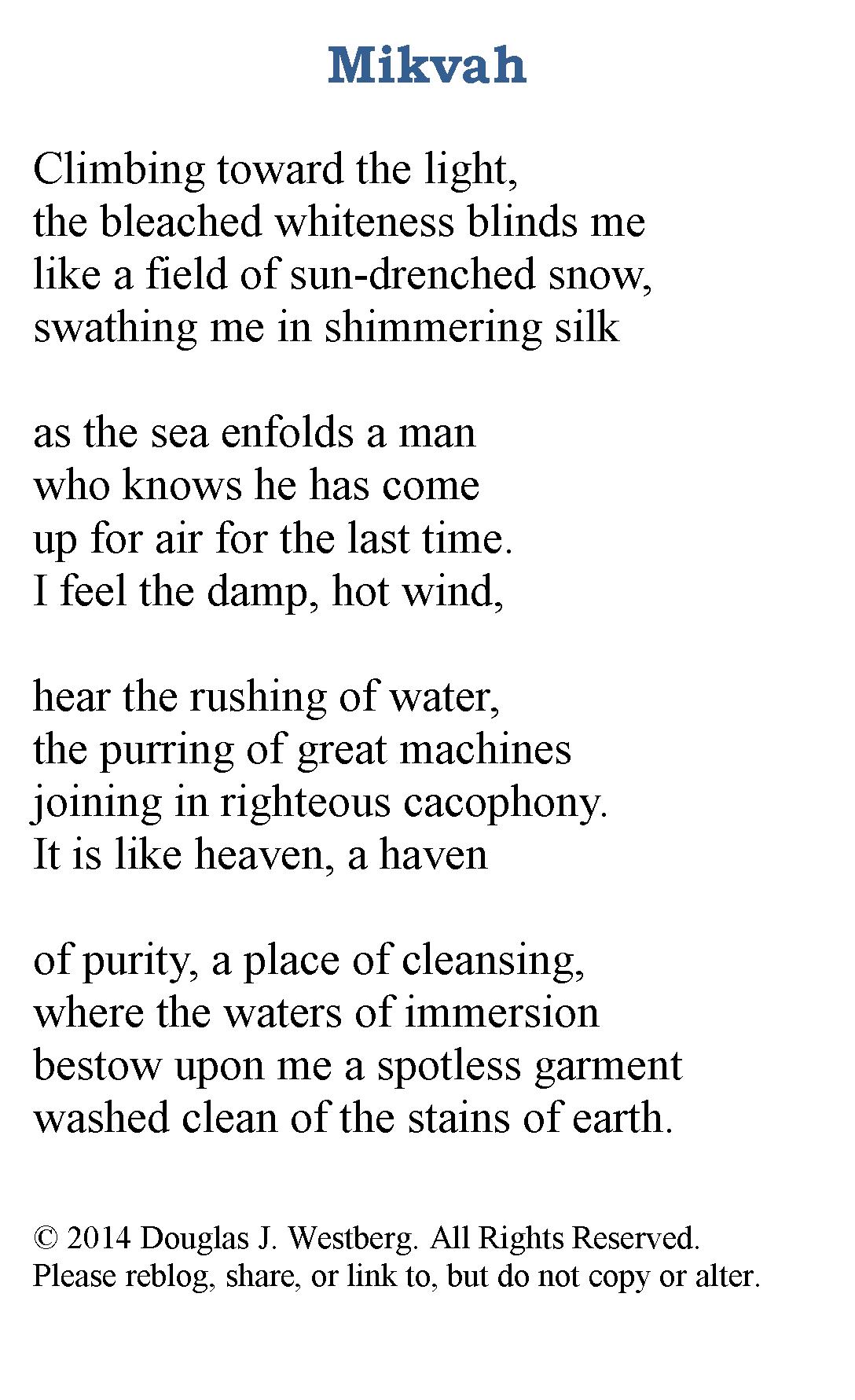
New Poem: Mikvah (formerly: Epiphany)

For those of you, all three of you, who are following my every post with bated breath, this was my initial attempt to write a modern-style* poem about death in response to my own prompt of Sunday. It wasn’t the poem I was trying to write (I succeeded on the second try). Comments welcome.

*When I say “modern-style,” it sounds a little silly, as though I were saying “new-fangled.” What I mean, precisely, is poetry in English in the period 1940-2000.

Update: I’ve been contemplating this some more and decided to rename it “Mikvah.” Mikvah is the Jewish purification ritual of immersion in water.

Mikvah

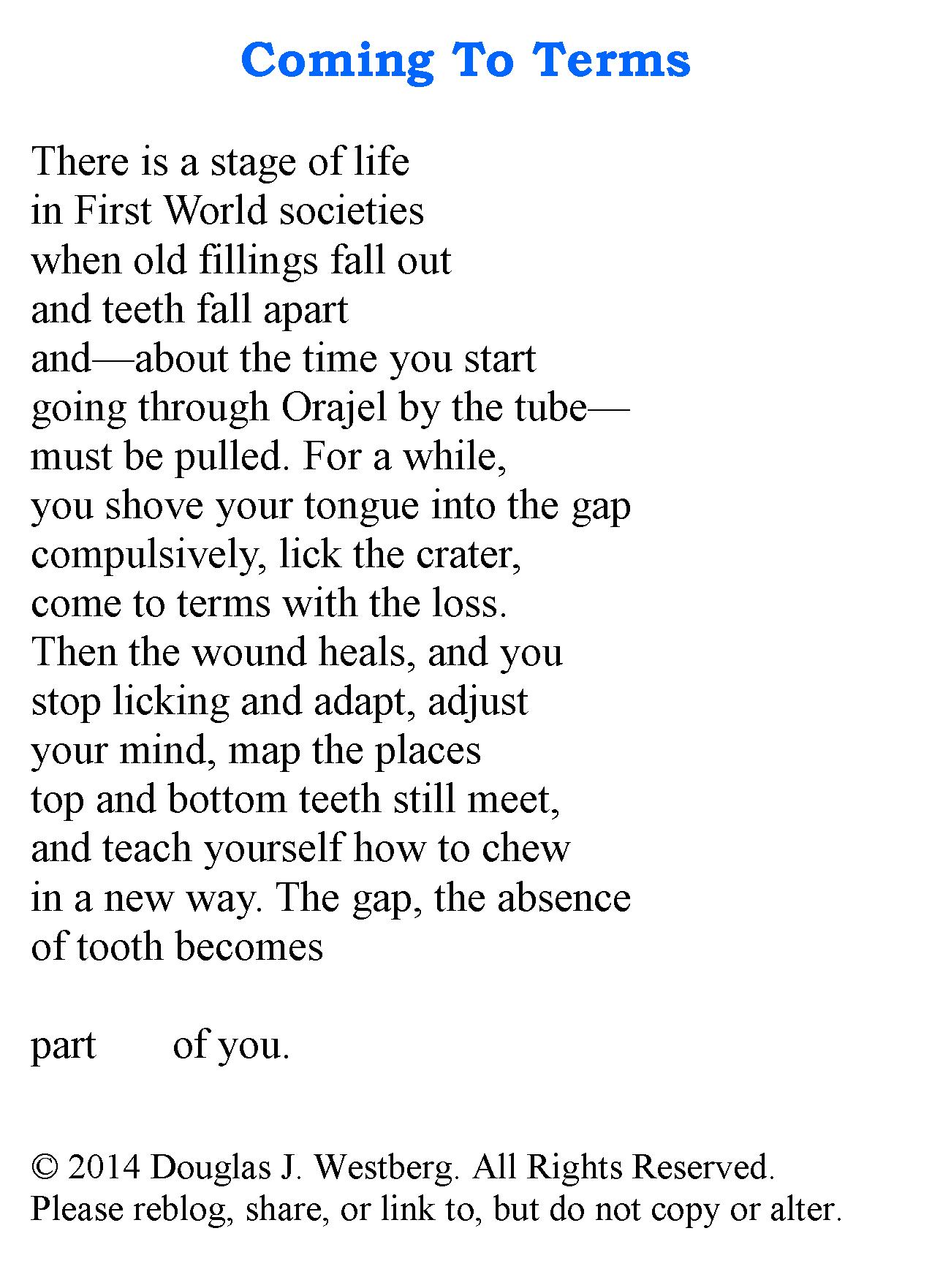
New Poem: Coming To Terms

Gentle Reader:

This is my response to my own prompt of yesterday. It took me two tries, interestingly. The first try turned into a different poem. I’ll post it later in the week.

This is what I meant by approaching the topic obliquely (from the side), metaphorically,  and on a small scale, more or less in the manner of William Carlos Williams and the other poets I cited in the column. This is but one approach; there are many others. Irina has taken a rather more sweeping and literal approach to the prompt and written a beautiful poem.

Coming To Terms


SunWinks! July 20, 2014: Where Is Thy Sting?

Dear SunWinkers!

Out, out, brief candle!
Life’s but a walking shadow, a poor player
That struts and frets his hour upon the stage
And then is heard no more.

            Shakespeare, Macbeth


SunWinksLogoI find myself being rather emotional these days. Last week, I spent four days in bed with the chest flu. This sort of inactivity and helplessness is very problematical for me as a trigger for depression. After another week, I’m still not my better self in terms of energy and industry.

Add to this… Continue reading

Exercise: Twenty Two Words from Eliot

Twenty-Two Words from Eliot


Burnt, I circumambulate my maisonette
in protozoic stupor,
mulling hollow images formulated
from the sawdust
of etherised metaphysics.

Outside the window-panes,
sun-kist hyacinths
dance with the arboreal shadows
falling across my tea and marmalade,
but I conjure only
broad-bottomed sea-girls
in ragged trousers.

Empty, I whimper
like a fugitive.
                             Empty
is the cruellest word.


© 2014 Douglas J. Westberg. All Rights Reserved. Please share, link to, reblog, but do not copy or alter.


The prompt (adapted from The Poet’s Companion [Kim Addonizio and Dorianne Laux; New York: W.W. Norton, 1997]):

Skim several books of poetry by, perhaps, your favorite poets. Without paying too much attention to the context, jot down words that strike your fancy. Go through the resulting list and pick out about twenty of these. Fashion them into a poem, using these words and as few other words as possible.

In this case, I started with a list of twenty words exclusively from T.S. Eliot poems. (I added “burnt” and “tea” as I went along.)