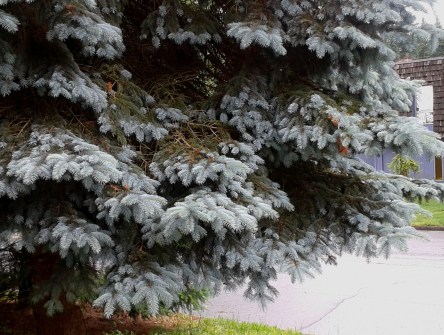
Baby blue needles
Offer up fresh pine cones to
Appease the Sun God
Dear SunWinkers!
Happy Father’s Day! I just want to say that it’s been an unalloyed privilege to live with my four children for the 28 years from when I married Nevada’s mother to when Hannah moved out. They are four of the sharpest, brightest, most beautiful and interesting human beings I’ve ever met. Yes, they could be infuriating. Yes, the challenges were overwhelming at times. But I treasure every single second because all of that made those children the people of whom I am so deeply proud and admiring today.
I’m on a new kick right now, taking pictures and writing haiku to go with them. Did you notice? This is not my first haiku kick. Actually, I think it’s my second. During my first poetry phase (c. 1998-2001), I wrote one haiku, and that was a spoof. My first haiku kick was less than a year ago—you can see them in my new book, Papa Doug’s Light Book of Little Verse.
Kick #2 started a week ago on a bike ride. I was greeted with an extraordinary sky as I was coming out of Value Village thrift store. I was greeted with another stunning vista halfway home. Thanks to my smartphone camera, these became SkyKu 1 and SkyKu 2. I love taking pictures because it’s such an undepressed thing to do. You have to have a sense of inquisitiveness and wonder, and to want to capture the image for future enjoyment and reflection. For me, it’s not just a pleasure, it’s a bellwether.
Going back to a picture, especially one I took myself, and writing a haiku, exploring the mystery and wonder of what I was looking at, is an additional pleasure. In fact, I have little interest in writing haiku about a picture I did not take. The point of haiku is to reflect on one’s own experience, on one’s own tiny movement of the soul produced from one’s identification with the natural.
Dear SunWinkers!
Last week, we looked at figures of speech, or rhetorical figures. They included anaphora (beginning a series of sentences or clauses with the same word or phrase), enallage (being effectively ungrammatical), and periphrasis (using more words than you have to).
In previous columns, I’ve talked about the music of poetry. The music of poetry goes back to a day when there was no such thing as music. St. Augustine’s De Musica (“On Music”), written around 390 A.D., actually treated the subject of what we now call poetic meter. Musical melody as we know it today came centuries later, and harmony years after that. So, meter is part of the music of poetry, not strict meter necessarily these days, but the feeling of rhythmic pulses, and meter implied, manipulated, and thwarted.
Diction and alliteration exemplify another aspect of music in poetry. The poet manipulates and takes advantage of the sound of language to make it grating, mellifluous, or narcotic, just as a composer uses harmony to make her music harsh or euphonious.
Dear SunWinkers!
I happened on an utterly fascinating book the other day: it’s Figures of Speech: 60 Ways to Turn a Phrase by Arthur Quinn [Salt Lake City: Gibbs M. Smith Inc., 1982]. It turns out there are at least 60 ways to turn a phrase, and every one of them has a Greek name.
 Quinn begins with the example: “We was robbed!” That’s the rhetorical device of enallage, which just means being effectively ungrammatical. (As the saying goes, “The Greeks have a word for it.”) Now, if Joe Jacobs, professional fight manager, had said in 1932, “We were robbed!” would anybody remember that? I doubt it.
By the same token, if Abraham Lincoln had said, “Eighty-seven years ago…” do you think anybody would be saying that today? There isn’t an American alive who hasn’t said at one time or another, “Four-score and seven years ago…” even if they’ve forgotten the rest of the Gettysburg Address. That’s the figure of periphrasis: using more words than you have to.
The Gettysburg Address and Martin Luther King Jr.’s “I Have A Dream” speech are full of powerful rhetorical flourishes. In Lincoln’s era and before, classes in rhetoric would be part of the curriculum. Those of course have gone the way of Latin classes, which a dwindling number of people would say is a shame. And at any rate, King doubtless learned his rhetorical skills in church, and Lincoln mostly learned from self-directed reading of whatever great literature fortuitously came his way. Which only goes to show there’s more than one way to separate a cat from its fur coat (another periphrasis).
“…that government of the people, by the people, for the people, shall not perish…” There are two devices in play here. Epistrophe is repeating a word or words (“the people”) at the end of a succession of phrases. Asyndeton is omitting an expected conjunction, in this case, an “and” before “for the people.” (The opposite device, Polysyndeton, adds conjunctions, as in Yeats’ “When you are old and gray and full of sleep.”)
Continue reading

…and The Poetry of Doug Westberg. Each edition of SunWinks! will be accompanied by a prompt or challenge at http://writingessentialgroup.com
Join the fun!
 SunWinks!