Dear SunWinkers!
I happened on an utterly fascinating book the other day: it’s Figures of Speech: 60 Ways to Turn a Phrase by Arthur Quinn [Salt Lake City: Gibbs M. Smith Inc., 1982]. It turns out there are at least 60 ways to turn a phrase, and every one of them has a Greek name.
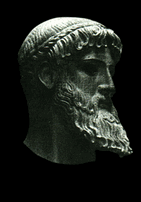 Quinn begins with the example: “We was robbed!” That’s the rhetorical device of enallage, which just means being effectively ungrammatical. (As the saying goes, “The Greeks have a word for it.”) Now, if Joe Jacobs, professional fight manager, had said in 1932, “We were robbed!” would anybody remember that? I doubt it.
By the same token, if Abraham Lincoln had said, “Eighty-seven years ago…” do you think anybody would be saying that today? There isn’t an American alive who hasn’t said at one time or another, “Four-score and seven years ago…” even if they’ve forgotten the rest of the Gettysburg Address. That’s the figure of periphrasis: using more words than you have to.
The Gettysburg Address and Martin Luther King Jr.’s “I Have A Dream” speech are full of powerful rhetorical flourishes. In Lincoln’s era and before, classes in rhetoric would be part of the curriculum. Those of course have gone the way of Latin classes, which a dwindling number of people would say is a shame. And at any rate, King doubtless learned his rhetorical skills in church, and Lincoln mostly learned from self-directed reading of whatever great literature fortuitously came his way. Which only goes to show there’s more than one way to separate a cat from its fur coat (another periphrasis).
“…that government of the people, by the people, for the people, shall not perish…” There are two devices in play here. Epistrophe is repeating a word or words (“the people”) at the end of a succession of phrases. Asyndeton is omitting an expected conjunction, in this case, an “and” before “for the people.” (The opposite device, Polysyndeton, adds conjunctions, as in Yeats’ “When you are old and gray and full of sleep.”)
I have a dream that my four little children will one day live in a nation where they will not be judged by the color of their skin but by the content of their character.
I have a dream today!
I have a dream that one day, down in Alabama, with its vicious racists, with its governor having his lips dripping with the words of “interposition” and “nullification” — one day right there in Alabama little black boys and black girls will be able to join hands with little white boys and white girls as sisters and brothers.
I have a dream today!
The device of repeating a word or words at the beginning of a succession of phrases or sentences is called anaphora.
Let freedom ring from Stone Mountain of Georgia.
Let freedom ring from Lookout Mountain of Tennessee.
Let freedom ring from every hill and molehill of Mississippi.
From every mountainside, let freedom ring.
Anaphora again. But here, he varies the rhythm by concluding the fourth line with “let freedom ring.” The technique of repeating a word or words at the beginning and then the end of a sentence or successive sentences is epanalepsis.
It’s just fascinating to be aware of these techniques even if you instantly forget most of the Greek terms. I recently wrote this poem after devouring Quinn’s book:
Christianity has its roots in the
epileptic hallucinations of two men:
Paul and Constantine.
The roots of Christianity
do not extend back to Jesus.
The device of repeating a phrase by reversing it (“Christianity has its roots…The roots of Christianity”) is called epanados. (Another is, “The Sabbath was made for man, and not man for the Sabbath.” Mk 2:27) Now, by the time I wrote this, I’d forgotten the Greek name, but I was aware of the technique, and that’s the point.
We’ll look at a few more of the more useful of these techniques next time. Meanwhile…
The Prompt
Write a short poem or short short story and try to work in one of the devices mentioned here. Maybe you’ll happen on a form of repetition or manipulation not mentioned here, and we’ll take a look at it and try to figure out if there’s a Greek name for that.
Post your response on your blog or social site (you could create a Note in Facebook) and comment to this post with a link to your response.
Love,
Doug
© 2014 Douglas J. Westberg
 SunWinks!
Reblogged this on Writing Essential Group.
LikeLiked by 1 person
Tough, but great prompt.
LikeLiked by 1 person
Great prompt and great tutorial. I sometimes wish I had had the opportunity to learn classical Greek. I did Latin for one year in high school.
LikeLiked by 1 person
My five years of Latin still pays dividends…
LikeLike
Wonderfully written (and I say that not just because you quote Lincoln). I’ve never known the names for the rhetorical devices you’ve mentioned, though I’ve tried to use them in my occasional writing. Great prompt.
LikeLiked by 2 people
Here is my contribution. I wrote this poem last year, it uses anaphora. It is divided into three stanzas starting with the word Window, but WordPress just didn’t want to obey although I went into Edit twice. http://irinadim.com/2014/05/28/window-2/
LikeLiked by 1 person
Commented at your blog. Thanks!!
LikeLike
Here’s mine. I wrote this few years ago for another prompt but I think it will work for this one too. http://maryrussel.blogspot.com/2014/05/the-sun-challenger.html
LikeLiked by 1 person
Found it and commented at your blog. Thanks!!
LikeLiked by 1 person