SunWinks! July 6, 2014: The H.M.S. Metaphor Sails Again
Dear SunWinkers!
A tasty confection the metaphor,
As sweet to an ode as a petit four,
A friend to the scribe,
Which, aptly applied,
Your poem will be so much the better for.
Last week, we introduced the idea that our language is built through metaphor. There were so many great stories to choose from, and all from just the one book: Loose Cannons, Red Herrings, and Other Lost Metaphors by Robert Claiborne [New York: W.W. Norton & Co., 1988]. (I have half a dozen others.) So this week, I’m just going to throw out a few more word stories and let you either work on last week’s prompt, or a completely different prompt which I’ve supplied below.

Annie Oakley
Phoebe Anne Oakley Mozee, a.k.a. Annie Oakley, gave shooting exhibitions in Buffalo Bill’s Wild West Show in the late 1800s. One of her most famous tricks was to throw a playing card into the air and shoot a hole in it. In that era, “comps,” complimentary tickets for theater or sporting events, had holes punched in them to prevent them being resold. Ban Johnson, founding president of the American League, took to calling such comps “Annie Oakleys,” and the name stuck. Later on, the nickname came to refer to other freebies, such as a walk in baseball. Alas, the nickname is virtually forgotten today.
Have you ever thought about where the name “cockpit” came from? As you might guess, it’s just what it looks like, a reference to the small sunken pits in which cockfights were held. A metaphorical cockpit is any small space in which intense fighting takes place, hence its application to the pilot’s compartment of a fighter plane.
A husband whose wife cheats on him is said to have been cuckolded. The word comes from cuckoo, and not just because said husband is likely to go a bit cuckoo. The European cuckoo customarily lays a single egg in the nest of another bird, letting the other bird brood and feed the cuckoo’s chick. From this, it’s a straightforward analogy to the cuckolded husband suspecting one of his kids was sired by the milkman.
A hackney was originally merely any kind of riding horse, as distinct from a draft horse or warhorse. From the 14th century, it came to mean a horse available for hire. We still call cabs and cab drivers “hacks.” By extension, a hack writer is one who cranks out work for hire, and work that is “hackneyed” is writing that sounds cranked out without a lot of thought or creativity.
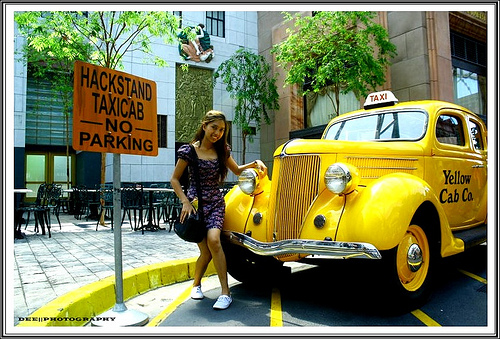
A hackstand
A political slush fund is a usually clandestine pool of money used for improper payoffs or kickbacks. In the days of sailing ships, cooks would boil up huge vats of meat stew for the crew. The slush (fat) that rose to the top was skimmed off and retained and sold at the next port of call to candle- and soap-makers. The proceeds from the sales were then used to buy little luxuries for the sailors.
If you enjoy these stories, you will want to pick up one of the many fine books on word and phrase origins. You may just find after enjoying enough of them that drawing a metaphor is becoming more second-nature to you.
FOR FURTHER READING
Claiborne, op. cit.
Wilfred Funk, Word Origins and Their Romantic Stories; New York: Bell Publishing, 1978.
Harold Wentworth and Stuart Berg Flexner, The Pocket Dictionary of American Slang; New York: Pocket Books, 1968. (I’m just pulling these out of my library. This book is an abridged version of The Dictionary of American Slang, both of which I’m sure have enjoyed many newer editions.)
James Rogers, The Dictionary of Clichés; New York: Ballantine Books, 1987.
Christopher J. Moore, In Other Words: A Language Lover’s Guide To The Most Intriguing Words Around The World; New York: Walker Publishing, 2004. The origins of some of the most colorful foreign words from many languages, some of which have come into English while more have not, which the author considers more or less untranslatable. Entries include bête-noire, enfant terrible, demi-monde, froufrou, schmuck, bupkis, schlock, nudnik, sub rosa, in flagrante delicto, yoga, guru, and powwow. Just fascinating.
Robert McCrum, William Cran, and Robert MacNeil, The Story of English; New York: Viking, 1986. Companion to the PBS television series, this is a thorough but extremely readable and lavishly illustrated chronological history of the development of the English language in cultures around the world. Chock full of fascinating stories of colorful words, dialects, and people.
The Prompt
Alternate Prompt
(from The Poet’s Companion [Kim Addonizio and Dorianne Laux; New York: W.W. Norton, 1997])
Skim several books of poetry by, perhaps, your favorite poets. Without paying too much attention to the context, jot down words that strike your fancy. Go through the resulting list and pick out about twenty of these. Fashion them into a poem, using these words and as few other words as possible.
Post your response on your blog. If it’s a WordPress blog, tag it WeSun. Or put it in a Note on Facebook or some such functionality, something you can link to.
Then comment to this post with the link.
© 2014 Douglas J. Westberg. All Rights Reserved. Please share, reblog, link to, but do not copy or alter.
 SunWinks!
Reblogged this on Writing Essential Group and commented:
Here’s your Sunday Writing Essential Group Prompt:
LikeLiked by 2 people
Bravo. I’m glad you kept this one going. I was afraid maybe you had had a cow. 🙂
LikeLiked by 1 person
Pingback: Exercise: Twenty Two Words from Eliot | SunWinks!
I’ve posted my own response to the alternate prompt above: Twenty Two Words from Eliot
LikeLike