Dear SunWinkers:
Years ago, I was struggling with deep depression, divorce, custody battle, blah blah blah. I started writing poetry as a form of therapy. I would usually begin by doing some automatic writing in my journal, just writing the next word that came into my head without thinking about it, and before you know it, there I would be, writing a poem.
Not too long ago, I wrote an experimental poem, just a goof, really, called “Listening In.” The idea was to “record” (not literally, the poem was a deliberate composition) what I heard and saw and what was going through my mind as I watched a Chicago White Sox broadcast with Ken “Hawk” Harrelson and Steve Stone. The poem leaps from inner thought to external action to thought to action to thought to action.
So, in a way, this is what is called stream of consciousness writing. Stream-of-consciousness writing differs from automatic writing in that the author composes the stream of thought that is putatively going through the character’s head. S-o-c writing eschews punctuation and sentence structure, hurtling along from thought to fragmentary thought. James Joyce, Virginia Woolf, William Faulkner, and Jack Kerouac are notable practitioners.
Robert Bly has coined the term leaping poetry, for writing which leaps willy-nilly between thought and action, or from the literal scene to the underlying metaphorical or spiritual content of the image. So “Listening In” incorporates that idea as well, not that it’s anything very profound:
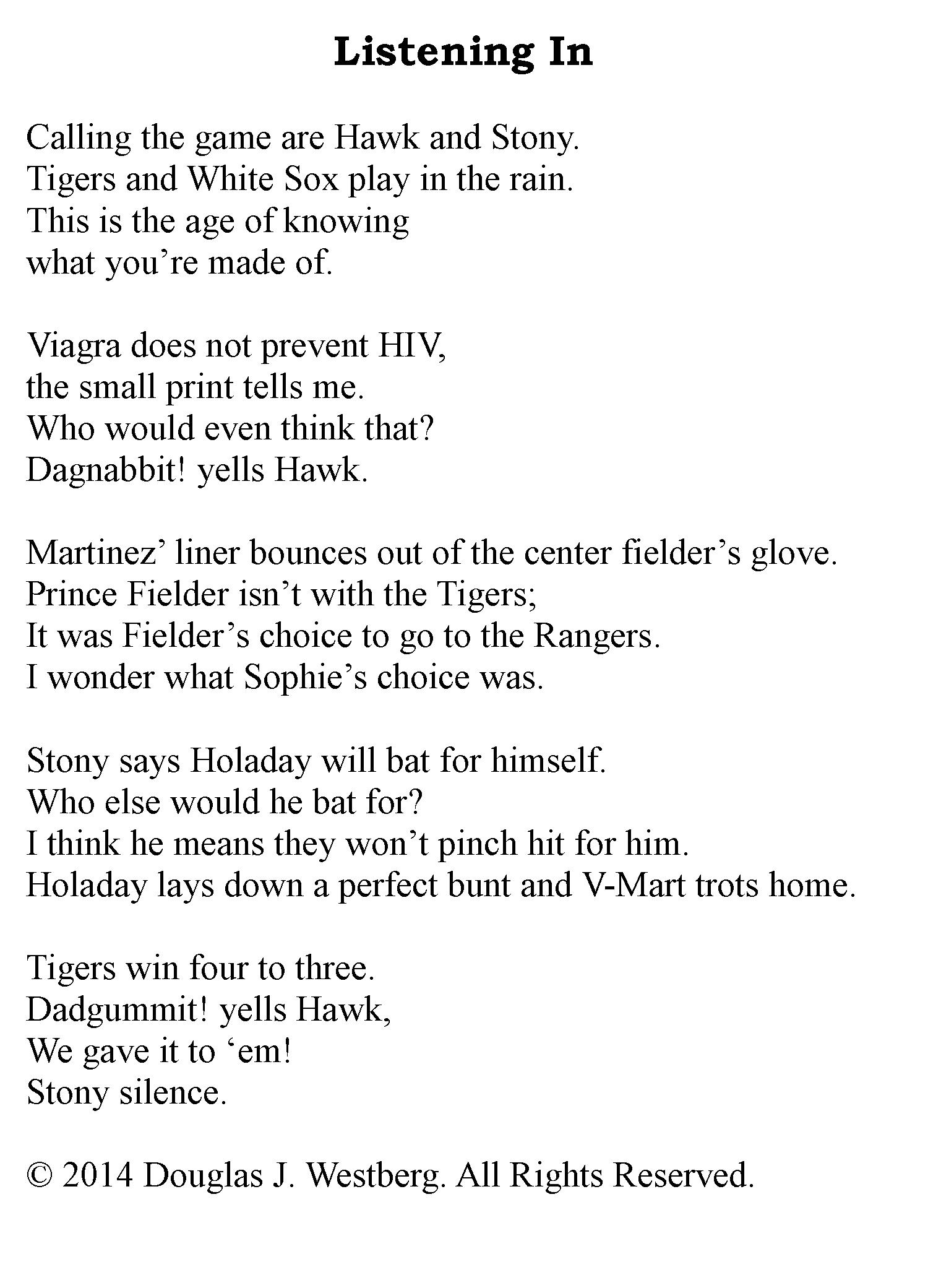
Poem: Hawk and Stony
In such techniques as these, interesting effects result from the juxtaposition of radically different images, subject matter, or points of view. The academicians call these effects associational logic. What I mean to do today is to encourage you to use this sort of technique to free up your writing and discover the poetic effects that can result from
- the rapid free association of disparate images and
- dispensing with the logic of
- grammar
- sentence structure
- overall structure or shape, and
- denotation or surface meaning of words and sentences.
Here are some more examples.
In Beloved by Toni Morrison, one of the characters has a conversation with two imaginary characters inside her head:
I was going to help you but the clouds got in the way.
There’re no clouds here.
If they put an iron circle around your neck I will bite it away, Beloved.
I will make you a round basket.
You’re back. You’re back.
Will we smile at me?
Can’t you see I’m smiling?
I love your face.
© Toni Morrison
Bly, who has published translations of a number of his poems, cites Pablo Neruda as a “leaping poet.” To my mind, this one could be describing a painting by Salvador Dali:
from “Melancholy Inside Families”
I keep a blue bottle.
Inside it an ear and a portrait.
When the night dominates
the feathers of the owl,
when the hoarse cherry tree
rips out its lips and makes menacing gestures
with rinds which the ocean wind often perforates—
then I know that there are immense expanses hidden from us,
quartz in slugs,
ooze,
blue waters for a battle,
much silence, many ore veins
of withdrawals and camphor,
fallen things, medallions, kindnesses,
parachutes, kisses.
[…]
Pablo Neruda
trans. © Robert Bly
Bly has also translated (here, with James Wright) the work of lesser-known Peruvian poet Cesar Vallejo:
from “Poem To Be Read and Sung”
I know there is someone
looking for me day and night inside her hand,
and coming upon me, each moment, in her shoes.
Doesn’t she know the night is buried with spurs behind the kitchen?
[…]
Cesar Vallejo
trans. © Robert Bly and James Wright
Jack Kerouac is today lumped in with the Beat Poets, but in actuality he precedes them slightly and inspired many of them:
from “Mexico City Blues, 211th Chorus”
[…]
Vast boars and huge gigantic bull
Elephants, rams, eagles, condors,
Pones and Porcupines and Pills—
All the endless conception of living beings
Gnashing everywhere in Consciousness
Throughout the ten directions of space
Occupying all the quarters in & out,
From supermicroscopic no-bug
To huge Galaxy Lightyear Bowell
Illuminating the sky of one Mind—
Poor! I wish I was free
of that slaving meat wheel
and safe in heaven dead.
© Jack Kerouac
One final note: our Aussie friend and colleague Irina Dmitric-Stojic tried to respond to my Cut and Shuffle prompt of last week. What flowed out of her pen was something quite different, and that’s terrific. That’s the way it works! The delightful result, as it happens, has much of the flavor of the stream-of-consciousness and leaping poetry we’ve been looking at: “A Poem Is Like An Orange”
The Prompt
Read the examples and let them inspire you to write something in a similarly improvisatory vein. If you’re having trouble getting started, start by doing some automatic writing. Write the next word that pops into your head, and the next, and the next. Don’t think about what you’re writing. At some point, the first line of your poem will hopefully pop out of your pencil and rap you on the head, the second line will write itself, and you’re off and running.
Alternate Prompt
Find a painting by Salvador Dali, such as “The Persistence of Memory” (Google it), in a book or on the web. Make up a little story about or involving what you see. Then write it up as a short short story or a poem. Or write the story and chop it up into a poem. Or write the story, chop it into 4-6-word chunks, then eliminate every other line, and make that your poem.
And don’t just read me! (Heaven forbid!) Look up the authors mentioned and read more of their work. Google the terms italicized above.
Post your response on your blog. If it’s a WordPress blog, tag it WeSun. If you don’t have a blog, put it in a Note on Facebook or some such functionality, something you can link to.
Then comment to this post with the link to your response.
I reblog this column at WritingEssentialGroup.com (you should be following that blog, too) and will post the links to your responses there. I will also comment on all responses.
Please don’t put your responses in a comment here on the SunWinks! blog. It won’t travel to the WEG group along with the post. (Okay, I confess, if you simply must put it in a comment, if it’s just not worth the trouble otherwise, I can link to it in a pinch. But it’s much preferable if clicking the link takes the reader to your blog.)
Finally, if you enjoy this, please be a good citizen and share this with your own friends and poetry circles.
Love,
Doug
© 2014 Douglas J. Westberg. All Rights Reserved. Please share, reblog, link to, but do not copy or alter.


Reblogged this on Writing Essential Group and commented:
Here is today’s Sunday Writing Essential Group prompt! Read! Share! Participate! Enjoy!
LikeLike
Hmmm…. This should be fun.
LikeLiked by 1 person
Yes, it should be fun ,so Pam, I expect a poem from you.
LikeLiked by 2 people
It would take me two hours to fully understand it, and then I’d probably get it wrong. Maybe.
LikeLiked by 2 people
Just write the next word that comes to your mind, and the next, and the next, and so on. You can’t get it wrong!! 😉
LikeLiked by 2 people
Pam, did you hear what Doug said? I’ll try and follow Doug’s suggestion. I feel the same as you about this one.
LikeLiked by 2 people
Doug, I always get it wrong, but maybe I’ll give it a shot.
LikeLiked by 2 people
I should have waited for this prompt to submit ‘A Poem Is Like An Orange’. Thanks for the mention above, Doug.
I’ll study again the poets you suggested. Often I don’t understand what they’re talking about.
LikeLiked by 1 person
I know, right? 😀
LikeLiked by 1 person
I got a little pedantic, sorry. [putatively…eschew…geez, Doug]
Don’t worry about the theory. As I said in the prompt, just look at the poems and see if they inspire you to write something in a similar vein. Don’t think about it too hard. Irina’s example is just the thing!
I added an alternate prompt as well. See above.
LikeLiked by 1 person
Here’s my contribution, Doug. I hope it fits this prompt!
LikeLiked by 1 person
Doug, I would appreciate your feedback.
LikeLiked by 1 person
Oops sorry. :-\ This reads like you recorded what was going on around you as it happened, which is fine. It’s great practice–you should do it all the time. The irony that the peace and quiet we experience as such isn’t really all that quiet is a cute bit.
As automatic writing, it makes too much sense, so it’s not strictly speaking automatic which is writing down the next (and the next and the next) word that goes through your head without processing (editing, thinking about) it. So try that, too!
Thanks for playing SunWinks, Irina! :-*
LikeLike
Thanks for your feedback, Doug. Yes, I understand, and I felt it wasn’t automatic writing. The thinking bit just imposed itself.
LikeLike
Pingback: On the Terrace (Sunwinks! 14 September 2014 Gently Down the Stream) | Irina's Poetry Corner
Doug, here’s my entry:
Although the painting is not by Dali, I think you will find it suitable for this prompt, as it is by a painter, Michael Cheval, who is heavily influenced by Dali and the painting even features Dali in it.
Michael Cheval and I have collaborated on quite a few projects together (I write stories/poems to accompany his paintings).
LikeLiked by 2 people
Appreciate if you could let me know Doug if my response was suitable. Just so you know, there’s another connection to Dali in my submission, as all the unusual words in the story (like “hyperxiological”, “atavistic vestiges” etc ) come directly from titles of Dali’s paintings.
LikeLiked by 1 person
Sorry. I have a little catching up to do. Your response was great! What an interesting painting. Didn’t catch that about the words. Very cool.
The ultimate goal, should you decide to accept it, is to now take this material and condense it into a “leaping” poem that perhaps sets up an expectation of normalcy and then hallucinatorily takes us in and out of a welter of different realms or angles of perception.
Thanks for playing!
LikeLike
thank you Doug, appreciate your feedback.
Not sure if I can do the “leaping” format for this particular piece, However, I have written a short story that uses that particular technique all through its narrative. It’s called “Amerika in the Sky(In Memoriam)” and for many readers, it’s my best piece of writing.
It’s a bit long, so it’s up to you if you want to read it Doug.
LikeLiked by 1 person