As the deer thirsts for flowing streams, so my soul longs for you, O Lord.
Ps. 42
Like a virgin, touched for the very first time…
Madonna
 Dear SunWinkers:
I’ve added an index of all the SunWinks! columns which I’ve posted here on WordPress since May. Find it among the Page links (with “About Me and SunWinks!” and “Submission Instructions”) and also at the bottom of each SunWinks! installment. It will help you enjoy the SunWinks! series in a more systematic way, like an online tutorial. With that, I’m going to start polishing up and recycling some of the 60+ columns I did on Gather in 2012-2013 to fill in the topics I need to create a complete tutorial and, ultimately, “SunWinks!: The Book.”
(I’m thinking of calling it “SunWinks!: How To Write Modern Poetry and Get Away With It.” Whaddya think?)
So, the next topic is Simile. That was the topic of the second column I did for Gather Writing Essential. I’ve saved every column but the first two; I know I’ve seen them on one of my computers, but haven’t been able to find them this week. So this one’s from scratch.
Simile is Metaphor Lite. It’s metaphor without the commitment, like a friend with benefits. Like metaphor, a simile is a comparison, but it’s a softer comparison, and an explicit one: “Truth is like an onion.” The words “is like an” announce that we are making a comparison. By asserting a similarity rather than an equivalence, a simile lets us ask, “In what way?” and “To what extent?” “Simile acknowledges the metaphor while backing away from it,” says Jay Parini.§
§[Why Poetry Matters; New Haven, CT: Yale Univ. Press, 2008.]
 A metaphor, on the other hand, is uncompromising. “And she balanced in the delight of her thought/A wren, happy, tail into the wind.”* Take it or leave it. And it’s an implicit comparison. “The yellow fog…that rubs its muzzle on the window-panes…”** It doesn’t announce, “Now I’m going to compare a fog to a dog.” It puts the two ideas together and lets you try to tease out, or even decide for yourself, why.
*Theodore Roethke “Elegy for Jane”
**T.S. Eliot “The Love Song of J. Alfred Prufrock”
There are many ways to draw a metaphor. You saw two of them in the previous paragraph. In the Roethke, the tenor (she) and vehicle (wren) are simply placed in apposition. In the Eliot, the vehicle (dog) is implied but not spoken. Instead, “dog” is represented by “muzzle”—a synecdoche, wherein a piece substitutes for the whole. The metaphor (fog…dog) and synecdoche (dog…muzzle) are telescoped, so that the intermediate step (dog) disappears. This sort of thing can seem tricky and confusing at first blush, until through practice and study it becomes second nature.
However, simile is one of the simplest and easiest ways to construct a metaphor: “The wind moves like a cripple.” But while the construction of the simile is less emphatic, the image can be just as powerful: “The cancer ate her like horse piss eats deep snow.” [Norman Dubie, “The Funeral”]
A simile doesn’t have to use “is like” as the operator. “As…as” is also a simile: “As dead as a doornail” goes the cliché. In my poem “The Incision,” I use a number of similes, including “Single-minded as a termite” and “brown and brittle as a breadstick.”
Making a striking or apt comparison is only part of what a simile can do. It can also amplify the theme and setting of the poem:
Suddenly nobody knows where you are,
your suit black as seaweed, your bearded
head slick as a seal’s.
Sharon Olds “Feared Drowned”
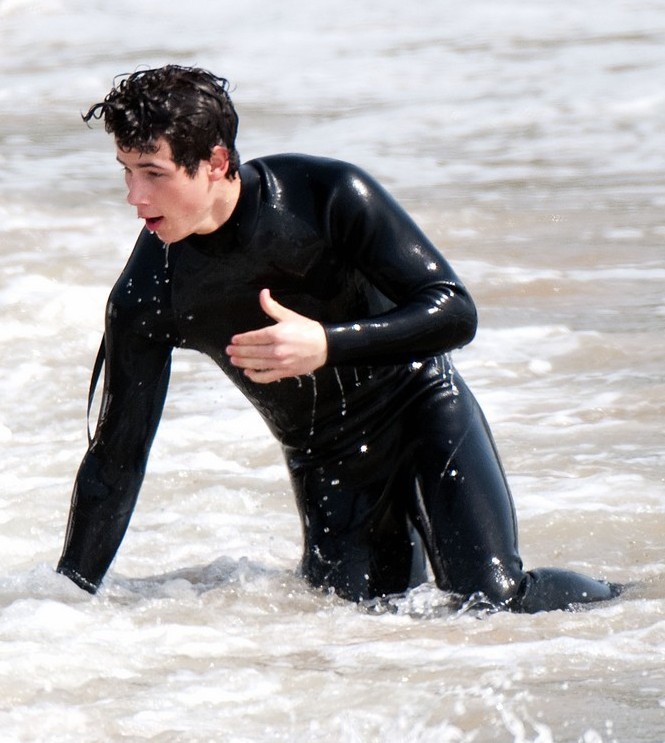 If Olds had written “your suit black as a piano key,” our mind’s eye would be wrenched away from the beach and into the piano bar. So a simile should not just be accurate, it should be germane to the subject; it should resonate with the theme. “Good metaphors and similes,” say Addonizio and Laux, “make connections that deepen, expand, and energize; they stimulate the imagination.”†
†[Kim Addonizio and Dorianne Laux: The Poet’s Companion; NY: Norton, 1997. I’m also grateful to them for the Dubie and Olds examples.]
Here are some more examples:
Time held me green and dying
Though I sang in my chains like the sea.
Dylan Thomas “Fern Hill”
When the evening is spread out against the sky
Like a patient etherised upon a table
T.S. Eliot “The Love Song of J. Alfred Prufrock”
When we walk in the sun
our shadows are like barges of silence.
Mark Strand “Seven Poems”
And there is the sleep that demands I lie down
and be fitted to the dark that comes upon me
like another skin in which I shall never be found,
out of which I shall never appear.
Mark Strand “The Sleep”
love is more thicker than forget
more thinner than recall
more seldom than a wave is wet
more frequent than to fail
e.e. cummings
The wind moves like a cripple among the leaves
And repeats words without meaning.
Wallace Stevens “The Motive for Metaphor”
The light is like a spider.
It crawls over the water.
It crawls over the edges of the snow.
It crawls under your eyelids
And spreads its webs there—
Its two webs.
Wallace Stevens “Tattoo”
to say
words like a
clear, fine
ash sifts,
like dust,
from nowhere.
Robert Creeley “Words”
Love like a burning city in the breast.
Edna St. Vincent Millay “Fatal Interview, XXVI”
The Prompt
Study the examples. Then write a short to medium-length poem, or prose poem, or piece of flash fiction, incorporating at least one simile.
Love,
Doug
Instructions for submitting your response to SunWinks!
© 2014 Douglas J. Westberg. All Rights Reserved. Please share, reblog, link to, but do not copy or alter.
 SunWinks!
Reblogged this on Writing Essential Group and commented:
Here’s your Sunday Writing Essential Group prompt. It’s, like, about simile. Enjoy! Share! Participate!
LikeLike
I’m anxious to see what Irina comes up with.
LikeLiked by 1 person
Indeed…
LikeLiked by 1 person
I’ve just read the tutorial. I’m in awe and my mind is blank!
LikeLiked by 1 person
Doug, I’m so glad to hear your excellent tutorials will be preserved in a book. The title is great.
Now I need to get down to work on the creation of some similes.
LikeLiked by 1 person
Here are my submissions Doug:
1) https://bozlich.wordpress.com/2014/11/26/ocean-in-a-fishbowl/
2) https://bozlich.wordpress.com/2014/11/26/the-happiness-catcher/
3) https://bozlich.wordpress.com/2014/11/26/remembrance-of-things-imperfect-main-theme/
5) https://bozlich.wordpress.com/2014/08/29/revelata-celestia-a-rhapsodic-transfiguration/
6) https://bozlich.wordpress.com/2014/11/26/remembrance-of-things-imperfect-variation-i-on-a-main-theme/
LikeLike
And just a general question: is it ok to resubmit pieces for, say Prompt X, if they have already been submitted in the past for, say Prompt Y?
LikeLiked by 1 person
Sure
LikeLike
Pingback: The First Kiss in the 1950s – SunWinks!: Simile and Friday Writing Essential: Youthful Memories | Irina's Poetry Corner
Here’s my entry:
LikeLike
Pingback: SunWinks! November 23, 2014: A Likely Story | Writing Essential Group